Model trains certainly run at a voltage low enough that they can be operated from batteries, and as lithium batteries...

Cart 0 Product Products (empty)
No products
Free shipping! Shipping
£ 0.00 Total
Product successfully added to your shopping cart
Quantity
Total
There are 0 items in your cart. There is 1 item in your cart.
Total products (tax incl.)
Total shipping (tax excl.) Free shipping!
Total (tax incl.)
Search Tips
Tips categories
Latest Tips
-
 Can you run a model train from batteries?Read more
 -
 What is a track rubber?Read more
A track rubber looks like a standard eraser that you would use to rub out unwanted pencil lines on a piece of paper....
-
 What is a superglue activator?Read more
A superglue activator, also known as a cyanoacrylate (CA) accelerator, is a chemical agent designed to speed up the...
-
 Is ballast grey or brown?Read more
Ballast can be either colour. If you are creating a layout of a prototype line then you should try and stick as...
-
 Where is the best place to store my layout when not in use?Read more
One of the trickiest issues with operating a model train layout is where to store it when not in use. There are a...

Is ballast scale or gauge specific?
Ballast is not typically scale or gauge specific, rather it is designed to be used with a specific type of model railway. The scale refers to the ratio of the size of the model railway to the real-life prototype, while the gauge refers to the distance between the rails. In most cases, Ballast can be used with different scales and gauges but it is always important to check the package to ensure that the ballast in question is appropriate for the specific gauge of the model railway.
For example, ballast that is designed for use with N Gauge model railway (1:160) will be much smaller than the ballast that is designed for use with OO scale (1:76.2) and larger than that for Z Gauge (1:220). It is important to note that the size of the ballast will change proportionately with the change in scale.
It is also important to ensure that the ballast you choose is appropriate for the gauge of your model railway. Most manufacturers will offer guidance on the packaging and many will supply ballast that can be used across a variety of different gauges. It is possible to use ballast that is not specifically designed for your gauge, but it may not look as realistic or fit as well as ballast that is specifically designed for your gauge. Ballast is also supplied in a variety of colours, textures and grain sizes to better replicate the different mediums that are used in different regions.
One technique that modellers use is to mix differing ballast mediums. This is not unrealistic as many regions used a variety of materials readily available rather than relying solely on one type. If there is any doubt about specific grain sizes it may be useful to err on the large side. If the grain does turn out to be too big then it can easily be ground down to a smaller size by careful use of a mortar and pestle.
In short, ballast is not generally scale or gauge specific. That said, it is always good to check the packaging of any product as the manufacturer will inevitably make recommendations as to its use.
Posted in: Model Railway
Click here to receive the tips weekly in your mailbox. You can unsubscribe at any time.
Related products
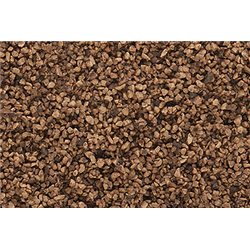
Brown Coarse Ballast
Price: £ 16.50Realistically model railroad track, crushed rock and stones. Easy to use and...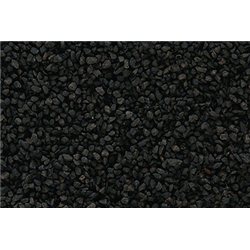
Cinders Coarse Ballast
Price: £ 16.50Realistically model railroad track, crushed rock and stones. Easy to use and...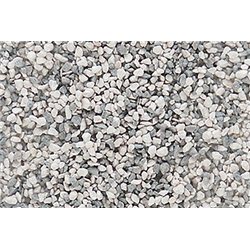
Grey Blend Medium Ballast
Price: £ 16.50Realistically model railroad track, crushed rock and stones. Easy to use and...
Related posts
-
 What scale is Hornby?Hornby model railways are OO Scale or 1/76th that is 4 millimetres to the foot (12 inches). It runs on a track with...
 - How to weight my model so it does not tip?For wargaming figures, a small coin or washer glued to the under side of the base will usually to do the job. This...
- Is Bachmann compatible with Hornby?Yes, any OO scale loco, wagon or coach will work on any OO scale track, regardless of brand. Couplings are also...
- What are the model railway eras?According to Bachmann, as it states in their catalogue there are 9 eras. As they say in their catalogue this is not...
- Can a "DCC ready" train be used on analogue?Yes, you can use a DCC ready train on your analogue layout. DCC ready just means that the train has been factory...