Kato track is a popular choice in the world of model railways, known for its quality, ease of use and versatility. If...

Cart 0 Product Products (empty)
No products
Free shipping! Shipping
£ 0.00 Total
Product successfully added to your shopping cart
Quantity
Total
There are 0 items in your cart. There is 1 item in your cart.
Total products (tax incl.)
Total shipping (tax excl.) Free shipping!
Total (tax incl.)
Search Tips
Tips categories
Latest Tips
-
 What is Kato track?Read more
 -
 How do I model industries on my layout?Read more
One of the most rewarding aspects of building a model railway is creating a realistic, living world in miniature....
-
 Were brake vans always positioned at the rear of a rake?Read more
Brake vans, also known as guards' vans or brake coaches, were typically positioned at the rear of a rake of wagons or...
-
 What is the best way to glue a cardboard building kit?Read more
The best way to glue a cardboard kit like Metcalfe or Superquick is to read and follow the instructions that are...
-
 How can I add rust and weathering effects to white metal parts?Read more
A number of modellers will work with white metal components as either part of their model or as additional...

Is Code 55 track a better option than code 80 track for my first N Gauge layout?
Code 55 and Code 80 are different types of model railway tracks, both are available for use on an N Gauge layout but they both have different characteristics.
Code 55 track has a finer rail profile and smaller spikes or tie plates than Code 80 track. This results in a more realistic and 'in scale' appearance and is often preferred by railway modellers who prioritise realism in their layouts. Additionally, it is worth noting that Code 55 track is also slightly narrower than Code 80 track, which makes it easier to fit into tight spaces.
Code 80 track, on the other hand, is more robust and durable than Code 55 track, making it a good option for layouts that will be frequently handled or transported. It's also slightly more forgiving than Code 55 track, making it easier to work with for beginners. For many modellers, the immediate visual differences between the codes are not always easy to spot and so given its strengths, Code 80 track is a pragmatic choice for many modellers.
For a first N Gauge layout, it may be easier to use Code 80 track as it's more forgiving for beginners but if realism is your primary concern, Code 55 track may be the better option. Both have their advantages and so inevitably the decision to opt for one code over another is a matter of individual preference.
There can be configuration issues when differing coded layout elements are mixed together. Therefore, before settling on a particular code for your layout, it is important to check the compatibility of the track type with the rest of the components you're planning to use, such as power supply and rolling stock.
Posted in: Tracks
Click here to receive the tips weekly in your mailbox. You can unsubscribe at any time.
Related products
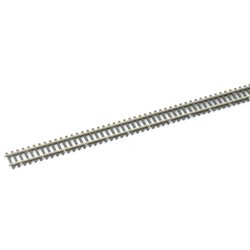
Nickel Silver Code 55 Wooden Sleepered (nickel...
Price: £ 6.70Nickel Silver Code 55 Wooden Sleepered (nickel silver rail) Flexible...
Related posts
-
 How to clean model railways track?There is of course the old tried and tested method, the track rubber which does the job, no railway modeller should...
 - Is Peco track and Hornby track compatible?Peco Setrack and Peco Streamline are compatible with Hornby track as they all share the same gauge width of 16.5mm....
- How often should I clean my track?This a hard question to answer. There are no hard and fast rules about how often you should clean the track. Bear in...
- How do I cut flexible track?Once upon a time I would have said a newly bladed junior hacksaw and some warding files, but these days I would have...
- How many pieces of curved track do I need to make a circle?As we all know it takes 360 degrees to create a circle, a standard curve is 22.5 degrees and a double curve is 45...