The best way to run a catenary system through a tunnel is to ensure proper planning and installation. Here are the...

Cart 0 Product Products (empty)
No products
Free shipping! Shipping
£ 0.00 Total
Product successfully added to your shopping cart
Quantity
Total
There are 0 items in your cart. There is 1 item in your cart.
Total products (tax incl.)
Total shipping (tax excl.) Free shipping!
Total (tax incl.)
Search Tips
Tips categories
Latest Tips
-
 What is the best way to run a catenary system through a tunnel?Read more
 -
 How can I keep parts in place during gluing?Read more
When gluing parts, it is best to hold them in place especially if it is a large area you need to join together, such...
-
 Where is the best place to store my layout when not in use?Read more
One of the trickiest issues with operating a model train layout is where to store it when not in use. There are a...
-
 Can I use WD-40 on my model railway locomotive?Read more
Every toolbox has a can of WD-40 in it to rid the world of squeaks and loosen any stubborn nuts and bolts, so the...
-
 What options do I have for motorising the waterwheel on a mill or the sails of a windmill?Read more
There are several options for motorising the waterwheel on a mill or the sails of a windmill on a model railway...

What are the differences between thin and thick Cyanoacrylate glues?
There are a number of different types of Cyanoacrylate or CA glue and each type has specific characteristics which help to determine where best to use them. CA Glues are readily identified by their respective viscosities. Regardless of manufacturer, most CA glues can be quantified as Thin (or Super Thin), Medium or thick.
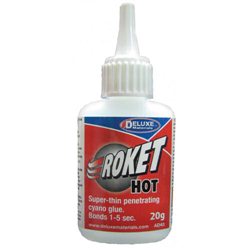
Thin, or Super-thin CA glue has the lowest viscosity of the three options and so it is the most mobile. It is especially effective when used where the working space for part placement is very small. It is also effective at filling very tight gaps as it efficiently uses capillary action to pull itself into very small spaces. The big advantage here is that comparatively small amounts can be used to secure parts and when used with care there should be minimal excess residue to clean up. The main disadvantage of Thin CA Glue is that it has a frighteningly quick cure time. Inevitably this requires the modeller to have the required pieces aligned so that they are ready to take the glue, as Thin CA will not allow time for experimentation or precision placement.
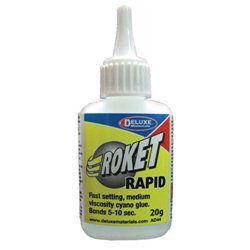
Medium CA glue has some inherent viscosity but if carefully applied will not run excessively. It is quick to cure but will also offer a strong joint. Most modellers will generally use a medium version of CA glue as it can be used in small quantities, it generally stays where you put it and it will afford any glued parts a strong bond. Thin CA glue works best where it can utilise the surface to its advantage. Medium CA is more flexible allowing it to be used in more remote locations or on smaller exposed parts where a strong bond is desirable.
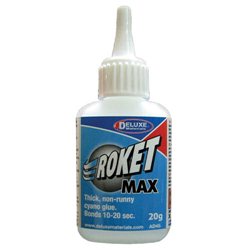
Thick CA glue has the greatest viscosity of all the CA glue variants. it is slow-moving and has the longest drying time of the three CA glue options. This allows it to be precisely positioned with ease via a toothpick or other similar item. It will generally stay where it is put and will allow some time for more precise alignment or positioning of parts. It is also a good option for securing larger items such as nuts or bolts that will not be required to move once placed. Additionally, it can be sanded once dried.
Posted in: Assembling and gluing
Click here to receive the tips weekly in your mailbox. You can unsubscribe at any time.
Related products
Related posts
-
 Do I need to wash my plastic kit?I personally wash all my plastic kits, I use warm soapy water (Washing up liquid) and a light rub over with a nail...
 - What is Milliput?Milliput is a two-part epoxy putty. There are two different colour rolls in a box when these are mixed together it...
- What modelling tools do I need to get started?Most modellers have an extensive tool kit, a tool for every eventuality. But when first starting a scalpel or a...
- How do I remove parts from the sprue?The short answer is carefully. The best way is with a sprue and plastic cutter but always be mindful of exactly...
- Do I need a cutting mat?It is not essential to have a cutting mat, but it is a good idea. It saves getting in trouble with your significant...