Choosing a brand new Revell kit to build is an exciting time, all of those shiny pictures on the boxes make you want...

Cart 0 Product Products (empty)
No products
Free shipping! Shipping
£ 0.00 Total
Product successfully added to your shopping cart
Quantity
Total
There are 0 items in your cart. There is 1 item in your cart.
Total products (tax incl.)
Total shipping (tax excl.) Free shipping!
Total (tax incl.)
Search Tips
Tips categories
Latest Tips
-
 What do the Revell skill levels mean?Read more
 -
 Where on my layout would I use a turntable?Read more
A turntable is a device that enables locomotives and/or rolling stock to change direction or orientation. It consists...
-
 Can I apply a simple wash to a matt surface?Read more
Yes, it is possible to apply a simple wash to a matt surface on a model railway. A wash is a thin layer of paint or...
-
 Can I use enamel-based paints in an airbrush?Read more
Enamel-based paints can be used in an airbrush but they need more specialised equipment and techniques to use. Enamel...
-
 What type of equipment is used to recover a derailed train ?Read more
When a train derails, it can be a challenging and complex task to recover it and get it back on track. Specialized...

What are the advantages of using Liquid Mask?
As the name suggests, 'Liquid Mask' (70.523) by Vallejo is a liquid-based masking agent, specially formulated for use by modellers. Liquid Mask can be used either in combination or as an alternative to traditional masking tapes or sheets to mask off areas prior to painting.
Liquid Mask can be applied directly over painted surfaces or onto clear plastic transparencies. It can be applied by brush or through an airbrush (recommended nozzle 1.4-1.7 mm) although if being applied over a painted surface it is essential that the painted surface is completely dry first. It will generally dry after 30 minutes but it is good to leave it for longer, especially where larger areas have been covered or if multiple layers have been applied. When dry, the applied mask will go completely transparent which can be a helpful indication that it is now ready for additional coats of paint. Liquid Mask can also be applied to uneven surfaces and unusually shaped contours where it would otherwise be tricky to apply traditional masking tape.
The Liquid Mask can be removed when the required painting has been completed. The mask can be removed in a number of different ways depending on the precise contours of the model, including a toothpick, a sharp hobby knife or a damp wide bristled paintbrush.
Liquid Mask can also be highly useful in the application of certain weathering effects, such as rust. Firstly, an appropriate rust-based undercoat should be applied to the area in question. Next, apply the Liquid Mask but in a haphazard or random fashion. This can be achieved by a small amount of mask applied to a small section of torn foam backing from a scouring pad, or by flicking Mask from a brush via a toothpick or other brush handle. Both of these methods will cause a suitably random pattern to occur. Once the mask is dry the appropriate top coat of paint can be applied and when this is dry the mask can gently be removed to reveal the rust-based undercoat. It can be beneficial to leave small areas of the mask in place as this can give a three-dimensional effect that complements the application of the mask. Additionally, this technique can be used in combination with other weathering techniques such as powders to create a really stunning visual effect.
Why not give Liquid Mask a try on your next project?
Posted in: Painting
Click here to receive the tips weekly in your mailbox. You can unsubscribe at any time.
Related product
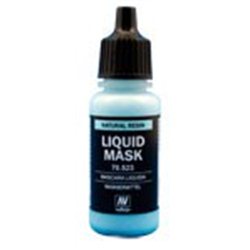
Model Color - Liquid Mask
Price: £ 3.00Model Color - Liquid Mask Used to reserve areas which are to remain...
Related posts
-
 Do I need to use a primer?For best results it is advisable to use a primer as this will stick to the plastic and give a uniform coat of paint...
 - What is weathering?Weathering is a painting technique used by modellers to create the appearance of dirt and grime and even damage to...
- How do I clean brushes used with enamel paint?Enamel paint is solvent based, so trying to wash in water will not work, you need to use white spirit. It is...
- How do I fill holes in a model?There are many products on the market for filling holes: There are plastic putties straight out of the tube, there...
- What is the best size paintbrush?This would depend on what you are painting as paint brushes come in various shapes and sizes. I would say for...