Adding weight to empty rolling stock can help to improve their running smoothness and reduce the risk of derailing on...

Cart 0 Product Products (empty)
No products
Free shipping! Shipping
£ 0.00 Total
Product successfully added to your shopping cart
Quantity
Total
There are 0 items in your cart. There is 1 item in your cart.
Total products (tax incl.)
Total shipping (tax excl.) Free shipping!
Total (tax incl.)
Search Tips
Tips categories
Latest Tips
-
 Should I add weight to my empty rolling stock to help them run smoother and avoid derailing?Read more
 -
 What would I use Tamiya Smoke (X-19) paint for?Read more
Tamiya X-19 Smoke is part of the Tamiya range of acrylic paints. As such it can be brush painted or can be airbrushed...
-
 For a beginner, what are the easiest ways to weather locomotives and wagons?Read more
Weathering locomotives and wagons is a great way to add realism and character to a model railway layout. For a...
-
 What is a puffer bottle?Read more
A puffer bottle is a manually operated specifically-shaped container that is used to prepare static grass for...
-
 How do I stop paint from bleeding under masking tape?Read more
When painting a model it is always possible that paint can seep underneath masking tape and thus ruin the painting...

Is airbrushing better than hand painting?
Both methods have their pros and cons.
It takes a little practice to get proficient in using an airbrush but once mastered is a great way of painting especially for large areas, weathering and varnishing, with time and technique there is very little that you cannot achieve with an airbrush apart from very fine detailing.
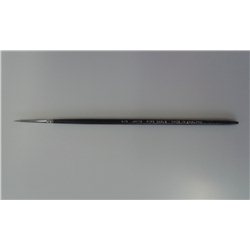
You will always need a good selection of paint brushes.
There are some very good tutorials online showing how to airbrush and hand paint. These are well worth watching even for the more seasoned modeller as there seem to be different techniques from many modellers appearing all the time.
If you do not yet have an airbrush it is definitely worth having, and once you start using it you will wonder why it has taken you so long to get one.
There will always be a need for paint brushes as some brushing techniques cannot be replicated by airbrushing.
Posted in: Painting
Click here to receive the tips weekly in your mailbox. You can unsubscribe at any time.
Related products
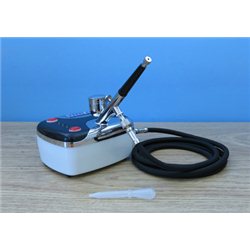
Super Detail Double action airbrush and compressor
Price: £ 99.95AB605 Expo Super Detail Airbrush Deal. Perfect for beginners and experienced...
Model Air - Rust
Price: £ 3.00Model Air - Rust Developed especially for airbrush techniques, with very...
Related posts
-
 Do I need to use a primer?For best results it is advisable to use a primer as this will stick to the plastic and give a uniform coat of paint...
 - What is weathering?Weathering is a painting technique used by modellers to create the appearance of dirt and grime and even damage to...
- How do I clean brushes used with enamel paint?Enamel paint is solvent based, so trying to wash in water will not work, you need to use white spirit. It is...
- How do I fill holes in a model?There are many products on the market for filling holes: There are plastic putties straight out of the tube, there...
- What is the best size paintbrush?This would depend on what you are painting as paint brushes come in various shapes and sizes. I would say for...