Many modellers can get through scalpel blades almost as quickly as surgeons do, but how should you dispose of them...

Cart 0 Product Products (empty)
No products
Free shipping! Shipping
£ 0.00 Total
Product successfully added to your shopping cart
Quantity
Total
There are 0 items in your cart. There is 1 item in your cart.
Total products (tax incl.)
Total shipping (tax excl.) Free shipping!
Total (tax incl.)
Search Tips
Tips categories
Latest Tips
-
 How to dispose of old scalpel blades safely?Read more
 -
 What is a back to back gauge?Read more
A back to back gauge is an instrument for measuring and setting up the distance between wheels on an axle of a model...
-
 What are the best tools to cut wooden parts such as planks for a period ship ?Read more
Wooden parts supplied with some kits can be quite thick and can offer significant resistance when a standard hobby...
-
 How to make realistic trees?Read more
If you do not want to buy pre-made trees, which these days look very realistic, you can get tree armatures which are...
-
 What is the difference between a boat and a ship?Read more
Finding cut and dry, black or white or definitive rules that without doubt define a vessel as a boat or a ship is not...

What is a wagon solebar?
A wagon's solebar is the outer longitudinal beam of its underframe or chassis.
Solebars are an integral part of a wagon's frame to which several components and supporting cross members are attached. The solebar is also where you're most likely to find features such as the hooks for tarpaulin ropes and identification plaques such as maker and registration plates.
The underframes of wagons, including the solebars, were originally made from wood which lasted little more than ten years before requiring replacement, later frames were made from iron before steel became the production material of choice thanks to its greater durability and ability to resist rust for longer.
Click here to receive the tips weekly in your mailbox. You can unsubscribe at any time.
Related products
Brake Van Chassis Kit 15ft Wheelbase steel type...
Price: £ 6.40Brake Van Chassis Kit 15ft Wheelbase steel type solebarsPeco Quality Line...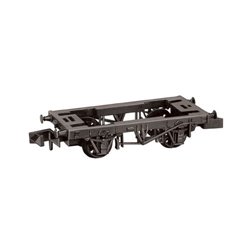
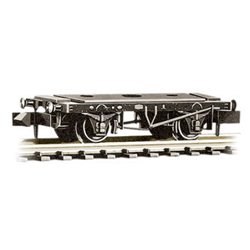
10ft Wheelbase wooden type solebars Chassis Kit
Price: £ 6.4010ft Wheelbase wooden type solebars Chassis KitPeco Quality Line Wagons....
Related posts
-
 What scale is Hornby?Hornby model railways are OO Scale or 1/76th that is 4 millimetres to the foot (12 inches). It runs on a track with...
 - How to weight my model so it does not tip?For wargaming figures, a small coin or washer glued to the under side of the base will usually to do the job. This...
- Is Bachmann compatible with Hornby?Yes, any OO scale loco, wagon or coach will work on any OO scale track, regardless of brand. Couplings are also...
- What are the model railway eras?According to Bachmann, as it states in their catalogue there are 9 eras. As they say in their catalogue this is not...
- Can a "DCC ready" train be used on analogue?Yes, you can use a DCC ready train on your analogue layout. DCC ready just means that the train has been factory...