Crackle medium is a weathering agent in a bottle, it has the appearance of a varnish. When you have primed your...

Cart 0 Product Products (empty)
No products
Free shipping! Shipping
£ 0.00 Total
Product successfully added to your shopping cart
Quantity
Total
There are 0 items in your cart. There is 1 item in your cart.
Total products (tax incl.)
Total shipping (tax excl.) Free shipping!
Total (tax incl.)
Search Tips
Tips categories
Latest Tips
-
 What is crackle medium?Read more
 -
 What is a DCC decoder CV?Read more
One of the jobs of a DCC decoder is to control pretty much everything that your model locomotive does, from starting...
-
 How can I model decay on model roads?Read more
Making model roads is easy thanks to the range of products available that can be used to fashion a suitable road...
-
 How can a 3D printer help with modelling?Read more
A 3D printer can be a game-changer for your projects, offering unprecedented control over design, precision and...
-
 What is a Seafire aircraft?Read more
In essence, a Seafire aeroplane is the same as a Spitfire, but with different adaptions to enable landing on aircraft...

What different types of hand drills are there?
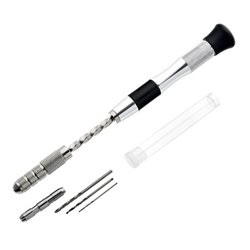
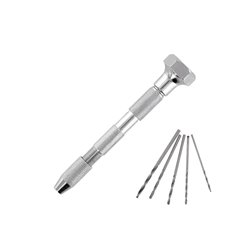
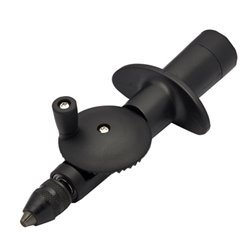
There are three main types of hand drills used in modelling, all with quite amusing or non-descriptive names including eggbeaters (officially known simply as hand drills or wheel braces), the Archimedean drill, which developed into the push drill and pin vices.
Traditional hand drills (eggbeaters) have a handle you turn to provide rotation to a drill bit via a gear, a push drill also produces a rotating motion but is operated by pumping the handle of the screwdriver-like device up and down as you work and a pin vice has no mechanism therefore is operated by screwing a bit through a surface in an action not too dissimilar to using a bradawl.
Hand operated drills specifically designed for modellers accept very small bits ranging from zero to just a couple of millimetres making them ideal for modelling projects. Although there are numerous other types of hand-operated drills available, these three are the most commonly used by modellers providing them with a means to drill holes with a precision that power tools would not allow.
Posted in: Assembling and gluing
Click here to receive the tips weekly in your mailbox. You can unsubscribe at any time.
Related products
Related posts
-
 Do I need to wash my plastic kit?I personally wash all my plastic kits, I use warm soapy water (Washing up liquid) and a light rub over with a nail...
 - What is Milliput?Milliput is a two-part epoxy putty. There are two different colour rolls in a box when these are mixed together it...
- What modelling tools do I need to get started?Most modellers have an extensive tool kit, a tool for every eventuality. But when first starting a scalpel or a...
- How do I remove parts from the sprue?The short answer is carefully. The best way is with a sprue and plastic cutter but always be mindful of exactly...
- Do I need a cutting mat?It is not essential to have a cutting mat, but it is a good idea. It saves getting in trouble with your significant...