To better answer this question it is probably best to establish a working scale for any comparison. The reason for...

Cart 0 Product Products (empty)
No products
Free shipping! Shipping
£ 0.00 Total
Product successfully added to your shopping cart
Quantity
Total
There are 0 items in your cart. There is 1 item in your cart.
Total products (tax incl.)
Total shipping (tax excl.) Free shipping!
Total (tax incl.)
Search Tips
Tips categories
Latest Tips
-
 Can Corgi or Matchbox style vehicles be used on a OO gauge layout?Read more
 -
 How can I add panel lines to a scale model?Read more
A lot of modellers like to add detail to their models. One of the things you can do to add realism to your model is...
-
 What paint do I use with Hydrocal?Read more
Hydrocal can be easily painted using acrylic paints.Hydrocal is a plaster-like substance many modellers use for...
-
 What's the difference between an AC and DC auxiliary port?Read more
Depending on the controller you are using, you may have an AC, a DC or both auxiliary ports on the back, but what's...
-
 What are the benefits of cleaning model components before painting?Read more
Before painting a model it is useful to give the parts a clean using mild detergent. One of the main advantages to...

What is meant by 'Bringing life to your layout or scene'?
Often, railway modellers talk about the importance of bringing their scene to life, but what does this mean? and why is it important?
Bringing a scene to life when everything in that scene is motionless is not an easy task. What you are trying to do is suggest activity, movement or situation even where there is none. This can be achieved using a few props and thoughtfully placed figures to hint at what your miniature people and vehicles would be doing if they could move.
Figures and vehicles are often placed on a layout to merely fill space or casually represent people with little regard to what they're doing or where they're going, and that's a good start, after all, any real street or station will feature many people and vehicles that give absolutely no indication of what they're up to and this anonymity should be modelled.
But saturate your scene with anonymity, and it could start to replicate a scene from a zombie movie. Real people when visiting a high street or using a railway station are likely to participate in activities other than walking or standing and encounter all sorts of situations, whether it be browsing in a shop window, chatting to a friend, crossing a road, dodging some scaffolding or queuing for a bus. On an average high street, you will also find workers busily delivering packages, erecting billboards, fixing or cleaning infrastructure and enforcing rules.
Recreating such scenarios on your layout will give your figures purpose and hint at their activity. This will not only better replicate real-life and bring the scene to life, but, also provide a more interesting scene for the viewers, whether they be at a show, a visiting friend or even the layout's creator during a quick play or running session.
A small scene within a scene that is created to suggest an activity or situation is known as a cameo scene and is the best way to suggest movement or life in a static display, roadworks, for example, provide something for workers to do, parked cars validate the presence of a parking warden, a pedestrian crossing turns walking people into crossing people and a bus stop turns standing people into queuing passengers.
Include a few cameo scenes on your layout and before you know it your once generic figures will be shoppers, builders, traffic wardens and passengers all displaying activity and life and all telling a story.
Posted in: Scenery
Click here to receive the tips weekly in your mailbox. You can unsubscribe at any time.
Related products
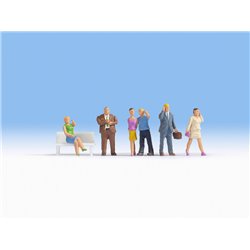
People with Mobile Phones - without Bench (6)
Price: £ 13.50People with Mobile Phones - without Bench (6)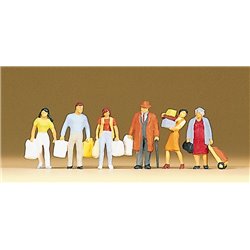
People Shopping (6) Exclusive Figure Set (HO/OO...
Price: £ 16.75People Shopping (6) Exclusive Figure Set (HO/OO gauge)Detailed plastic...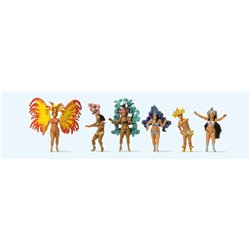
Carnival Samba Dance Group (6) Figure Set
Price: £ 36.50Carnival Samba Dance Group (6) Figure Set Detailed plastic miniature figures,...
Related posts
-
 Is static grass better than scatter?I use both, separately and together. Static grass comes in various sizes from 0.5mm to 12mm while scatter is...
 - How do I apply static grass?Static grass is best applied using a static grass applicator. There are several on the market and they can apply...
- What colour are tree trunks?Tree trunks are actually grey in colour and not brown as you would think. The next time you are out and about just...
- How to make hills?You can make hills in a variety of ways. The tried and tested way is with chicken wire and papier mache. This is a...
- How do I glue scatter?Select the area where you want the scatter, then apply a layer of PVA glue, sprinkle your grass covering the glue....