Motorising a level crossing can add a realistic touch to the operation of a layout. There are several options...

Cart 0 Product Products (empty)
No products
Free shipping! Shipping
£ 0.00 Total
Product successfully added to your shopping cart
Quantity
Total
There are 0 items in your cart. There is 1 item in your cart.
Total products (tax incl.)
Total shipping (tax excl.) Free shipping!
Total (tax incl.)
Search Tips
Tips categories
Latest Tips
-
 What are my options for motorising a level crossing on my layout ?Read more
 -
 What is the best paint to use on a metal locomotive kit?Read more
The best paint to use on a metal locomotive kit depends on your personal preference and the desired finish. Here are...
-
 What is the difference between 00 and H0?Read more
If you have ever wondered into your local model shop to admire, dream about or even treat yourself to a 00 gauge...
-
 What is a wet palette?Read more
Fine painting is always something best done with patience. The problem is, when using acrylic paint if you take too...
-
 How do I attach figures to my layout?Read more
This depends on what type of figures you are using for your layout. If you are using white metal figures they often...

What is a DMU?
DMU stands for Diesel Multiple Unit. DMUs are a type of train where the coaches have their own diesel-powered engines to propel them along negating the need for a locomotive at the head of the train. The driving controls on DMUs are situated in an integrally mounted driver's cab located at the ends of the leading and trailing vehicles facilitating the train to easily travel in either direction.
Although there were early experiments with diesel railcars, DMUs were first introduced in any great numbers during the later years of steam. Originally they were introduced as a modern and cost-effective way for the railway to operate branch-lines and suburban services. DMUs were cheaper, cleaner and more efficient to operate than steam-hauled trains, they didn't require a locomotive to run around the train at terminus stations, and being diesel, were less labour intensive to get started in the mornings. The new DMUs lower running costs and practicality was soon realised and DMUs have since played an increasing role in meeting rail transport needs through into the 21st century even on express and long distance services.
For modern rail operators, the main advantage of DMUs is that they can lengthen or shorten trains by simply adding or removing additional compatible DMUs. This tactic has a direct impact on running costs because shortening a train, by default, reduces the amount of motive power being used proportionately, therefore, reducing diesel consumption and wear.
Despite the clear advantages of DMUs, they are not hugely popular with customers who take longer journeys, the under-floor diesel engines create noise and vibration that isn't apparent when travelling on a traditional locomotive-hauled train. To this end, a few rail operators are now reintroducing locomotive-hauled services, but this is only cost-effective on routes with high passenger numbers meaning that DMUs are here to stay.
Click here to receive the tips weekly in your mailbox. You can unsubscribe at any time.
Related product
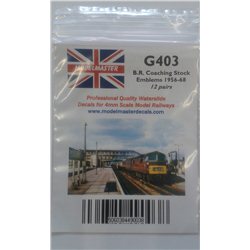
12 Pairs of 1956 - 68 style Coaching Stock...
Price: £ 7.4012 Pairs of 1956 - 68 style Coaching Stock Crests (Also used on some Locos &...
Related posts
-
 What scale is Hornby?Hornby model railways are OO Scale or 1/76th that is 4 millimetres to the foot (12 inches). It runs on a track with...
 - How to weight my model so it does not tip?For wargaming figures, a small coin or washer glued to the under side of the base will usually to do the job. This...
- Is Bachmann compatible with Hornby?Yes, any OO scale loco, wagon or coach will work on any OO scale track, regardless of brand. Couplings are also...
- What are the model railway eras?According to Bachmann, as it states in their catalogue there are 9 eras. As they say in their catalogue this is not...
- Can a "DCC ready" train be used on analogue?Yes, you can use a DCC ready train on your analogue layout. DCC ready just means that the train has been factory...