When it comes to historical eras for model railway layouts in the UK, there are several popular choices. However, one...

Cart 0 Product Products (empty)
No products
Free shipping! Shipping
£ 0.00 Total
Product successfully added to your shopping cart
Quantity
Total
There are 0 items in your cart. There is 1 item in your cart.
Total products (tax incl.)
Total shipping (tax excl.) Free shipping!
Total (tax incl.)
Search Tips
Tips categories
Latest Tips
-
 What is the most popular historical era for model railway layouts in the UK?Read more
 -
 Is black the best wash colour to use?Read more
Washes are generally used to add shade or grime to a model, whether it be a model train, car or figure, a wash can...
-
 Do I need expansion gaps on my railway layout?Read more
It is generally recommended to incorporate expansion gaps or expansion joints into your model railway layout,...
-
 What are powerbase plates used for?Read more
Powerbase plates sound as though they're going to be very high-tech with lots of microchips, wires and a complex...
-
 Is electricity on a model train track dangerous?Read more
Electricity is inherently dangerous and should always be treated with respect. But with model railways the voltage...

What is a locomotive headlamp?
Lamps have been used on the front of railway locomotives since the mid-1800s. All through the steam years, the lamps consisted of oil-burning units that were hung on the front of locomotives on special brackets called lamp-irons. Surprisingly, their use had little to do with illuminating the track ahead for drivers to see, their actual function was to inform signallers of what type of train was approaching.
This was important information for signallers especially before the absolute block system was introduced in the latter half of the 19th century. Before then trains were permitted to follow each other through a section of track after a timed interval, so knowing what type of train had passed would allow signallers to leave an adequate gap before allowing the next one to proceed.
To indicate what type of train was being hauled, the lamps would be arranged on the front of trains in different patterns by utilising four lamp-irons (three along the buffer beam and one central one at the top) and anywhere between a single and four lamps. This provided enough combinations to advise the signallers of at least a dozen different train types which were categorised according to weight, speed, ability to stop and importance.
Post absolute block, the practice of using lamps continued, now though on an increasingly busy rail-network, signallers were using the information to prioritise trains to keep the system moving by giving priority to faster and more important trains. The exception to the rule was the more congested and complex Southern Regions, these lines were becoming so busy that signallers had their hands full directing the sheer volume of traffic that was being thrown at them, so lamp positions were used as route indicators to minimise mistakes.
Headlamps were used in this way right up to early dieselisation with very early examples sporting integral electrically operated white lights in the same patterns as their steam predecessors. Eventually, the lights were replaced by indicator-code displays which were in turn superseded by computers. Trains still have headlamps today to show the direction of movement, to alert others of the approaching train, to aid driver vision at night and on rare occasions to alert oncoming trains to a danger on the line, but nowadays the lights are high-intensity LEDs and you don't need a match to switch them on!
Posted in: Model Railway
Click here to receive the tips weekly in your mailbox. You can unsubscribe at any time.
Related products
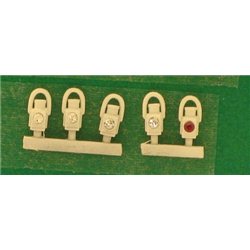
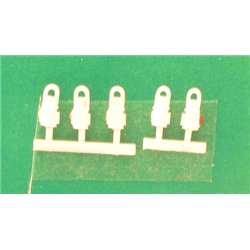
LNER Head & Tail Lamps White (5)
Price: £ 6.95Lner Head & Tail Lamps Lamps White (5)Lamps require removing from sprues and...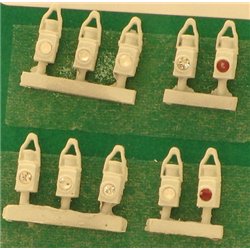
BR Head & Tail Lamps White (10)
Price: £ 11.95BR Head & Tail Lamps White (10)Lamps require removing from sprues and gluing...
Related posts
-
 What scale is Hornby?Hornby model railways are OO Scale or 1/76th that is 4 millimetres to the foot (12 inches). It runs on a track with...
 - How to weight my model so it does not tip?For wargaming figures, a small coin or washer glued to the under side of the base will usually to do the job. This...
- Is Bachmann compatible with Hornby?Yes, any OO scale loco, wagon or coach will work on any OO scale track, regardless of brand. Couplings are also...
- What are the model railway eras?According to Bachmann, as it states in their catalogue there are 9 eras. As they say in their catalogue this is not...
- Can a "DCC ready" train be used on analogue?Yes, you can use a DCC ready train on your analogue layout. DCC ready just means that the train has been factory...