There are many reasons why model trains derail, sometimes it's a track fault, sometimes it's because the train isn't...

Cart 0 Product Products (empty)
No products
Free shipping! Shipping
£ 0.00 Total
Product successfully added to your shopping cart
Quantity
Total
There are 0 items in your cart. There is 1 item in your cart.
Total products (tax incl.)
Total shipping (tax excl.) Free shipping!
Total (tax incl.)
Search Tips
Tips categories
Latest Tips
-
 Why does my train keep derailing?Read more
 -
 Should I use a brush to apply varnish?Read more
When applying varnish to protect a model's paintwork, you should aim for a finish that exhibits the least amount of...
-
 What is balsa glue and how do I use it?Read more
Balsa glue is a specialised adhesive designed specifically for bonding balsa wood. It's often the preferred choice...
-
 What is Hornby Dublo?Read more
Hornby Dublo was an early brand name for models produced by the company that we now all know as Hornby. The brand was...
-
 What are the filler caps for on the running board of a Jubilee Class?Read more
Railway modellers love details, but sometimes a prototype's details can leave us scratching our heads and wondering...

What is an electrical relay?
Electrical relays perform so many different tasks that it would be very difficult to definitively say that a relay does X, Y or Z, but in essence, relays are switches that operate without you having to be there.
There are no doubt many experts that will provide much more in-depth analogies of a relay, but jargon doesn't help any poor soul that is trying to understand them for the first time. An electrical relay in its most basic form is a large switch and a small switch all in one casing, the smaller switch operates the larger switch.
The biggest application for this seemingly overly-complicated setup is when you need to operate a very powerful circuit, a switch capable of turning such a circuit on or off would have to be much larger and more heavily engineered than your basic pound-shop toggle switch. The solution to this is to have a simple low voltage circuit with a neat little switch and tidy wiring that controls the smaller switch inside the relay, in turn, the relay's smaller switch takes care of turning the high powered circuit on or off. The beauty of this system is you don't have to be anywhere near the high-powered circuit at the time, the low-powered circuit can lead to a pound-shop toggle switch far away or even be automated to be triggered by, for example, a train passing over a certain section of track.
To put it another way, if you think about the many different types of manual switches there are in the home, controlling everything from simple lights to a plug socket and imagine how relatively simple that circuit would be. Now consider more complicated electrical equipment such as a dishwasher or microwave oven that rely on remote-control, sensors, programmable keypads or timers to operate, then relays start to make more sense and furthermore you start to get an idea of how many different types of relay there must be.
With this in mind it is not likely that you will face a modelling problem that makes you think of a specific relay to solve it, but at least knowing that relays exist and what they can do, you can ask at an expert store and maybe discover that the solution to your problem is just one relay away.
Posted in: Power and control
Click here to receive the tips weekly in your mailbox. You can unsubscribe at any time.
Related products

Universal Relay Switch
Price: £ 8.25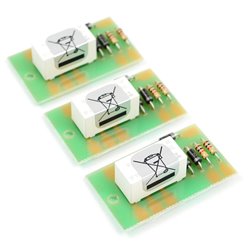
Universal Relay Switch (3 Pack)
Price: £ 22.00Universal Relay Switch (3 Pack) The GM500 is a self latching relay that works...
Related posts
-
 Can a "DCC ready" train be used on analogue?Yes, you can use a DCC ready train on your analogue layout. DCC ready just means that the train has been factory...
 - Is it difficult to fit a DCC decoder in to a DCC ready engine?In theory, it should be easy as the whole idea of being DCC Ready is to simplify the process. The first time I did...
- What is 7/0.2 wire?7/02 wire is a wire made of 7 strands of 0.2mm wire. Stranded wire has the advantage of being flexible while solid...
- Is an N Gauge controller compatible with OO Gauge?Yes, an N Gauge controller is compatible with OO gauge trains. You may have to change the power clip to the track...
- Is stranded wire better than solid wire?In my experience, stranded wire is preferable over solid wire. Stranded wire is more flexible than solid core wire,...