All Hornby track is compatible with Peco track. There is a misconception that different brands will not work...

Cart 0 Product Products (empty)
No products
Free shipping! Shipping
£ 0.00 Total
Product successfully added to your shopping cart
Quantity
Total
There are 0 items in your cart. There is 1 item in your cart.
Total products (tax incl.)
Total shipping (tax excl.) Free shipping!
Total (tax incl.)
Search Tips
Tips categories
Latest Tips
-
 Are Hornby points compatible with Peco track?Read more
 -
 How much weight should I add to my rolling stock?Read more
We have all been there, with that wagon or coach that derails all of the time, and we suspect that the reason for...
-
 What is a unifrog turnout?Read more
A unifrog turnout can perform as an electrofrog or an insulfrog turnout, that means that there is no longer a need...
-
 How do I test the width between the wheels of my engines?Read more
The best way to check the wheels of your locomotives is to use a tool called a back to back gauge. They are...
-
 What is departmental stock?Read more
Departmental rolling stock is great for modellers. Often it is an excellent excuse to run much earlier locomotives...

Why do rail joiners and fishplates fail after time?
For those not in the know, rail joiners are the little metal clips (sometimes referred to as fishplates) that connect sections of model railway track together. Specifically, it's the metal rail part of the track section that slides into the rail joiner and, when connected, performs two functions. Firstly, the rail joiner keeps the two sections of track together and secondly, it ensures electrical continuity from one section of track to the next, but after time they can become unreliable.
There are two ways in which rail joiners fail, often they can become loose, especially if the track is taken apart and put together frequently. The reason for this is fairly obvious as the rail joiners gradually lose their shape and don't grip the opposing rail as well as they did when new. This will result in a loss of adhesion and electrical contact. But what about those that have never lifted their tracks and have even glued them down? Then one day they simply stop conducting the current and dead spots start appearing all over the layout.
This is likely due to oxidisation and corrosion. Metal rails and the rail joiners themselves will react to air and moisture. As tight as you may think your rail joiners were on the day your track was laid, there would always have been minute spaces small enough to not feel or notice but large enough for air or moisture to find a way in. This effect would have been greatly accelerated if your tracks received a good dowsing of water to apply a PVA solution to the ballast.
But sometimes air and natural room humidity can wangle their mischievous way into our rail joiners even without provocation from us modellers in pursuit of the perfect ballast, and it's all thanks to temperature variations (especially in lofts or garages). As in real life, rails expand when they get hot and contract when they're cooler, this creates all the movement joiners need to gradually wiggle loose and let air in.
One solution to this problem is to apply a spot of solder on your rail joiners when laying your track. This will provide an airtight electrical connection that will not allow oxidisation to take place. Another good practice is to install a bus-wire connecting power to multiple locations around your layout. Not only will this help compensate for any dodgy rail joiners, but it will also combat voltage-drop on larger layouts which is where current loses its oomph over long distances.
At the end of the day, the more things you can do to combat oxidisation the better your trains will run, and for longer.
Click here to receive the tips weekly in your mailbox. You can unsubscribe at any time.
Related products
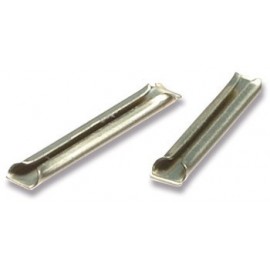
Rail Joiners (24 in a pack)
Price: £ 5.10Rail Joiners, compatible with Peco and Hornby track. 24 in a pack
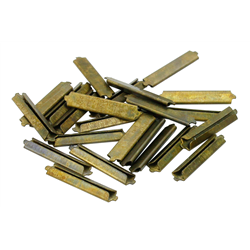
Bag of 25 Elite fishplates
Price: £ 8.50Bag of 25 Elite fishplates. Chemically darkened Nickel silver
Related posts
-
 How to clean model railways track?There is of course the old tried and tested method, the track rubber which does the job, no railway modeller should...
 - What scale is Hornby?Hornby model railways are OO Scale or 1/76th that is 4 millimetres to the foot (12 inches). It runs on a track with...
- Is Peco track and Hornby track compatible?Peco Setrack and Peco Streamline are compatible with Hornby track as they all share the same gauge width of 16.5mm....
- How to weight my model so it does not tip?For wargaming figures, a small coin or washer glued to the under side of the base will usually to do the job. This...
- How often should I clean my track?This a hard question to answer. There are no hard and fast rules about how often you should clean the track. Bear in...