The first thing you need to know when calculating gradients is that it doesn't matter which unit of measurement you...

Cart 0 Product Products (empty)
No products
Free shipping! Shipping
£ 0.00 Total
Product successfully added to your shopping cart
Quantity
Total
There are 0 items in your cart. There is 1 item in your cart.
Total products (tax incl.)
Total shipping (tax excl.) Free shipping!
Total (tax incl.)
Search Tips
Tips categories
Latest Tips
-
 How do I calculate the space needed for an incline on my model railway layout?Read more
 -
 What are my options for motorising a level crossing?Read more
There are a few options for motorising a level crossing on a model railway layout: Servo motor: One option is to use...
-
 What is a back to back gauge?Read more
A back to back gauge is an instrument for measuring and setting up the distance between wheels on an axle of a model...
-
 How often should I run my locomotives to avoid performance issues?Read more
To avoid performance issues, it is generally recommended that modellers run their locomotives on a regular basis. The...
-
 In simple terms what is tabletop gaming?Read more
Tabletop gaming is a form of gaming where players gather around a table and use physical game pieces, such as...

Why don't more modellers fit smoke generators to their engines?
Smoke generators are a great idea for introducing an extra level of realism to your locomotives. The concept is simple enough, you can buy a kit containing a smoke generating chimney with two wires attached to connect to your locomotive, some instructions and a bottle of oil to get you started. So why are so many modellers reluctant to install one?
Well, it is true enough that connecting one is easy, you simply connect the smoke generator's wires (one positive and one negative) to the pickups on your locomotive, then pop a few drops of oil down the chimney, turn on the controller and watch the steam (smoke) flow. However, most models today will present you with one major problem; space.
Not only does your model have to provide you with enough space to cram a generator in. That space will also have to be vertical, so unlike finding a space for a decoder or sound chip where any crevice will do, it must also be a space of specific size, located directly under the model's chimney and vertical. The likelihood of meeting those criteria is slim, but not completely unheard of.
So how do some modellers achieve it?
Often modellers that fit smoke generators are very experienced, they are willing, fearless and knowledgeable enough to alter or adapt their prized models (and sometimes they are just lucky when it comes to available space).
But if you fancy giving it a go, why not try it as an experiment with an old unloved engine first, after all, how else are you going to become willing, fearless and knowledgeable!
Posted in: Model Railway
Click here to receive the tips weekly in your mailbox. You can unsubscribe at any time.
Related products
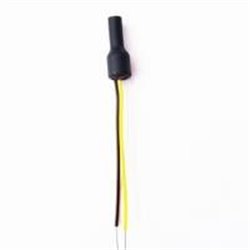
DISC**No 27 Smoke Unit 10 - 16v
Price: £ 34.00No 27 Smoke Unit 10 - 16v These units can also be used for buildings to...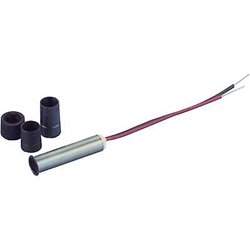
DISC**Smoke unit for 8-14v plastic locos
Price: £ 34.00Smoke unit 14v locos with plastic bodies 8-14 volts, current draw 140ma. 2...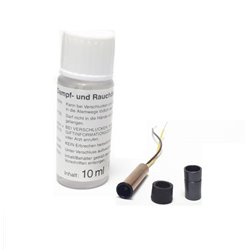
DISC**Smoke unit for up to 16v plastic body
Price: £ 34.00Smoke unit for up to 16v plastic body These units can also be used for...
Related posts
-
 What scale is Hornby?Hornby model railways are OO Scale or 1/76th that is 4 millimetres to the foot (12 inches). It runs on a track with...
 - How to weight my model so it does not tip?For wargaming figures, a small coin or washer glued to the under side of the base will usually to do the job. This...
- Is Bachmann compatible with Hornby?Yes, any OO scale loco, wagon or coach will work on any OO scale track, regardless of brand. Couplings are also...
- What are the model railway eras?According to Bachmann, as it states in their catalogue there are 9 eras. As they say in their catalogue this is not...
- Can a "DCC ready" train be used on analogue?Yes, you can use a DCC ready train on your analogue layout. DCC ready just means that the train has been factory...