If you were painting a red brick wall, to get a realistic effect, I would, after the wall had been primed with a...

Cart 0 Product Products (empty)
No products
Free shipping! Shipping
£ 0.00 Total
Product successfully added to your shopping cart
Quantity
Total
There are 0 items in your cart. There is 1 item in your cart.
Total products (tax incl.)
Total shipping (tax excl.) Free shipping!
Total (tax incl.)
Search Tips
Tips categories
Latest Tips
-
 What colour should I use to paint brick walls?Read more
 -
 Why won’t my engine run after adding a 6 pin DCC decoder?Read more
This is quite straight forward as there are no real instructions on fitting 6-pin decoder. If you find that your...
-
 How can I protect my track from oxidisation ?Read more
Oxidation, also known as rust, can be a common problem for model railway tracks, especially if they are exposed to...
-
 Is an exhibition layout different from a home layout?Read more
If you are accustomed to the world of model railways, then you'll already know what an exhibition layout is, but for...
-
 What is a solenoid?Read more
If you are building or own a model railway layout, then you have likely heard the word solenoid, a lot! and that is...

Can I add smoke to my trains?
In theory, yes you can add smoke to your engines regardless of whether you are running analogue or DCC.
You will need to get yourself a smoke generator which is fitted inside the body of your engine and connected to the pickups of the train, you will also need some smoke oil.
Simply put a few drops of smoke oil inside the generator and smoke will be made. The higher the speed of the engine, the higher the voltage and the more smoke you will see.
Please note, in reality, you may not be able to fit a smoke generator inside your engine as there may not be the space. Smoke generators require between 5 and 9mm of width and are usually 24 or 36mm tall. Depending on your engine, you may not be able to drill out the chimney enough to fit the generator.
Click here to receive the tips weekly in your mailbox. You can unsubscribe at any time.
Related products
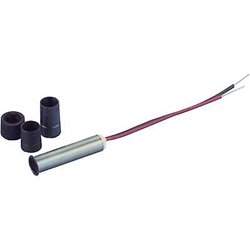
DISC**Smoke unit for 8-14v plastic locos
Price: £ 34.00Smoke unit 14v locos with plastic bodies 8-14 volts, current draw 140ma. 2...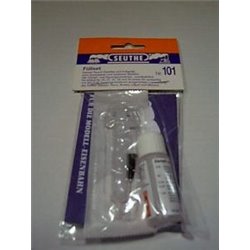
DISC**Filling set for smoke units
Price: £ 7.50Filling set for smoke units Smoke fluid for use with Seuthe Smoke Units or...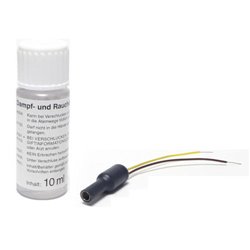
Related posts
-
 How to remove super glue (cyanoacrylate)?Cyanoacrylate is best known as super glue. The best way to remove it is with acetone or an acetone-based product...
 - What scale is Hornby?Hornby model railways are OO Scale or 1/76th that is 4 millimetres to the foot (12 inches). It runs on a track with...
- How to weight my model so it does not tip?For wargaming figures, a small coin or washer glued to the under side of the base will usually to do the job. This...
- What are ejector pins?Ejector pins are used in the injection moulding process of the manufacturing of plastic kits and die cast kits. They...
- Is Bachmann compatible with Hornby?Yes, any OO scale loco, wagon or coach will work on any OO scale track, regardless of brand. Couplings are also...