Long before computer systems were introduced, signal boxes, stations and goods yards communicated with each other by...

Cart 0 Product Products (empty)
No products
Free shipping! Shipping
£ 0.00 Total
Product successfully added to your shopping cart
Quantity
Total
There are 0 items in your cart. There is 1 item in your cart.
Total products (tax incl.)
Total shipping (tax excl.) Free shipping!
Total (tax incl.)
Search Tips
Tips categories
Latest Tips
-
 What are railway telegraphic codes?Read more
 -
 What is feedback on an analogue controller?Read more
Feedback on an analogue controller is a function that detects if your model train is experiencing difficulty climbing...
-
 How do I paint panel lines on my model aircraft?Read more
There are various techniques for adding these fine lines to your model. I always give my model a coat of gloss...
-
 What is a good way to temporarily mount figures on my layout?Read more
Whether they are from Noch, Preiser, Faller, Merten, Bachmann, Woodland Scenics or another manufacturer, when it...
-
 What to ask yourself before starting a layoutRead more
If you are just starting out on your model railway adventure and you are trying to decide what type of layout to...

What is the purpose of a backscene?
A backscene is an essential component of a model railway layout, providing a visual backdrop that enhances realism and immerses the viewer in the scene you are creating. Its primary purpose is to frame the layout, offering a sense of context and scale. By representing the environment beyond the immediate railway track—be it rolling countryside, urban skylines, or industrial landscapes—a backscene helps to ground the layout in a believable setting.
A backscene often reflects the distinctive character of local geography, architecture and weather. Whether it’s the misty hills of the Lake District, the industrial mills of the Midlands or the terraced streets of a Northern town, a well-chosen backscene sets the tone for the entire layout. It connects the individual elements of your railway—such as buildings, track, and rolling stock—with a broader narrative, making the scene feel complete and cohesive.
Another key purpose of a backscene is to create the illusion of depth. While most model railway layouts operate within limited physical space, a backscene can trick the eye into believing the landscape extends far beyond the edge of the baseboard. Techniques such as perspective, subtle shading, and carefully scaled imagery can make hills, buildings or skies appear distant, adding a sense of grandeur to even the smallest layout. This is especially important in smaller homes, where space for a model railway is often at a premium.
Backscenes also serve a practical purpose by disguising the edges of the layout. Without a backscene, the viewer’s eye is drawn to walls, furniture or other distractions in the surrounding room, breaking the illusion of the miniature world. A thoughtfully designed or painted backscene eliminates these intrusions, focusing attention solely on the railway and its setting. In addition, a backscene can help to hide wiring, shelving, or other functional but unsightly parts of the layout.
For many modellers, the process of creating a backscene is an opportunity to express artistic flair. Whether you opt for a printed backscene, hand-paint your own or use a combination of both, this element allows for creativity in capturing the mood and atmosphere of the scene. A dramatic stormy sky, for instance, could reflect the unpredictability of British weather, while a serene sunset might evoke a sense of nostalgia.
It’s also worth noting the role of lighting in enhancing a backscene. Proper lighting can bring out the subtle details of a backscene, making colours appear more vibrant and shadows more realistic. For example, simulating morning or evening light can add warmth and drama, aligning the backscene with the story of the layout. Many modellers experiment with LED strips or spotlights to achieve these effects.
In essence, a backscene is more than just a decorative element; it’s a vital part of storytelling in model railways. By thoughtfully designing or choosing a backscene that complements your layout’s theme, you can elevate your railway from a simple collection of tracks and scenery to a truly immersive miniature world. Whether you're a beginner or an experienced modeller, investing time and effort into your backscene will undoubtedly pay off in the realism and enjoyment of your layout.
Posted in: Scenery
Click here to receive the tips weekly in your mailbox. You can unsubscribe at any time.
Related products
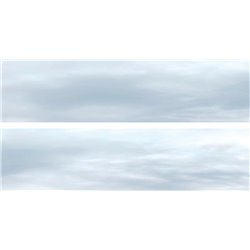
Overcast sky 2 x 5' x 15''
Price: £ 16.50Overcast sky 2 x 5' x 15'' Sets connect together to form a larger image: set...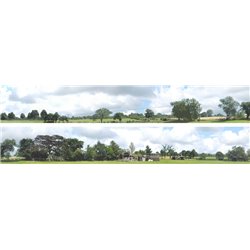
Into the Town Backscene - Set D 2 x 5' x 9''
Price: £ 12.99Set d 107 backscenes 2 x 5' x 9'' Sets connect together to form a larger...
Related posts
-
 Is static grass better than scatter?I use both, separately and together. Static grass comes in various sizes from 0.5mm to 12mm while scatter is...
 - How do I apply static grass?Static grass is best applied using a static grass applicator. There are several on the market and they can apply...
- What colour are tree trunks?Tree trunks are actually grey in colour and not brown as you would think. The next time you are out and about just...
- How to make hills?You can make hills in a variety of ways. The tried and tested way is with chicken wire and papier mache. This is a...
- How do I glue scatter?Select the area where you want the scatter, then apply a layer of PVA glue, sprinkle your grass covering the glue....