The hairspray technique is a process used to add chipping effects to the surface of a model, using a can of aerosol...

Cart 0 Product Products (empty)
No products
Free shipping! Shipping
£ 0.00 Total
Product successfully added to your shopping cart
Quantity
Total
There are 0 items in your cart. There is 1 item in your cart.
Total products (tax incl.)
Total shipping (tax excl.) Free shipping!
Total (tax incl.)
Search Tips
Tips categories
Latest Tips
-
 What is the hairspray technique for painting?Read more
 -
 How do I connect track?Read more
The track is connected using rail joiners, also called "fishplates". They are thin metal plates that simply slot...
-
 Eco-friendly scale modelling: sustainable greener practices and materialsRead more
Despite the title of this article being a bit scary, we simply want to explore sustainable practices and materials...
-
 Should I use Enamel or Acrylic paint?Read more
These are two very different paints, some people prefer to use enamel as it is hard wearing usually with a glossy...
-
 What is P4 (Protofour)?Read more
P4 (also known as Protofour) is as true to the scale of 4mm to 1ft (1/76 scale) as you can get, giving a true...

Can I use HO gauge figures on an OO scale layout?
Yes, you can use HO figures on your OO scale layout, there is a slight difference in size, but this is negligible in the grand scheme of things.
HO gauge is 1/87th that is 3.5mm to the foot, where as OO scale is 1/76th, that is 4mm to the foot. So HO is very slightly smaller but an example may help understand better:
In OO gauge, a typical 6ft tall man (1.80m) would be about an inch (24mm to be exact), in HO, the same man would be 21mm. The same 21mm tall figure would represent a man who is 1.60m (5ft 4in) tall.
As we are all different shapes and sizes, the difference in size does not really matter and it matters even less if you simply stick to one size on your layout, be it HO or OO.
I usually make sure that HO gauge figures and OO gauge figures are not next to each other to avoid any obvious visual clash but apart from that, I am happy to mix them on a layout.
Click here to receive the tips weekly in your mailbox. You can unsubscribe at any time.
Related products
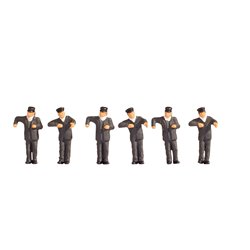
Steam locomotive drivers - Set of 6 - Painted
Price: £ 14.50Set of 6x hand-painted steam engine drivers.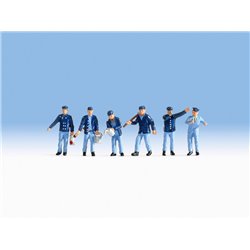
Engine Driver & Shunters set - Painted
Price: £ 14.50A set of 6x hand-painted figures including a loco driver and shunters, by...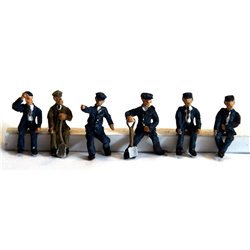
Loco driver and fireman seated figures 6...
Price: £ 8.40Set of 6 white metal figures depicting steam engine drivers and firemen in...
Related posts
-
 Do I need a respirator?If you are using an aerosol spray paint you should always use one. Always read the manufacturer’s...
 - How to remove super glue (cyanoacrylate)?Cyanoacrylate is best known as super glue. The best way to remove it is with acetone or an acetone-based product...
- What is the best wood for baseboards?The most common wood for baseboards is probably chipboard as this is relatively inexpensive. Plywood is another...
- How do I stick parts together for a test fit?There are several trains of thought on the best way to secure parts together temporarily. Some suggest using a small...
- How to clean model railways track?There is of course the old tried and tested method, the track rubber which does the job, no railway modeller should...