One of the perennial problems of being a modeller is that our models or layouts sometimes become very efficient dust...

Cart 0 Product Products (empty)
No products
Free shipping! Shipping
£ 0.00 Total
Product successfully added to your shopping cart
Quantity
Total
There are 0 items in your cart. There is 1 item in your cart.
Total products (tax incl.)
Total shipping (tax excl.) Free shipping!
Total (tax incl.)
Search Tips
Tips categories
Latest Tips
-
 How can I prevent my layout becoming a dust trap when not in use?Read more
 -
 What is the skill level on Airfix kits?Read more
When deciding which Airfix kit to buy most people will understandably want to choose one that is relevant to their...
-
 What is a stay-alive?Read more
A stay-alive (or keep-alive) is a capacitor that can be used with a DCC decoder. It stores power to allow for a more...
-
 What are the tips for cleaning and preparing white metal parts for assembly ?Read more
White metal is a popular material used in scale modelling, particularly for model railway enthusiasts. It is a type...
-
 Is it possible to use insulated fishplates to isolate a section of track?Read more
Yes, it is possible to use insulated fishplates to isolate a section of track. Insulated fishplates, also known as...

How can I stop my wagons from derailing on the tight turns of my layout ?
One common issue that model railway enthusiasts often face is wagons derailing on tight turns. This can be frustrating and can interrupt the smooth running of the layout. Fortunately, there are several steps that can be taken to prevent wagons from derailing on tight turns.
Let's explore some of these solutions :
Check the track alignment : the first step is to ensure that the track is properly aligned. Misaligned track sections can cause wagons to derail, especially on tight turns. Use a straightedge or a track alignment tool to check if the track is straight and properly connected. Adjust any misaligned sections to ensure a smooth transition from straight track to the curve.
Increase the curve radius : one of the main reasons for derailments on tight turns is the sharpness of the curve. Consider increasing the curve radius by widening the turn. This will provide a gentler transition for the wagons and reduce the chances of derailment. If possible, replace the tight turn with a larger radius curve.
Check for obstacles : another factor that can cause derailments is the presence of obstacles near the track. Ensure that there are no objects, such as buildings, scenery elements, or other structures, that might obstruct the movement of the wagons on the tight turns. Clear any obstructions or adjust the track layout accordingly.
Improve the track bed : a stable and level track bed is crucial for preventing derailments. Make sure that the track is securely fastened to the baseboard or layout surface and that any track pins are flush with the surface. Use foam or cork underlay to provide a smooth and level surface for the track. This will help to absorb any irregularities in the baseboard and reduce the chances of wagons derailing.
Check the wheelsets : inspect the wheelsets of any wagons for any obvious damage or misalignment. Ensure that the wheels are properly seated in the axle and that there is no excessive play or wobble. Clean the wheels regularly to remove any dirt or debris that might affect their performance.
Add weight to the wagons : light wagons are more prone to derailing, especially on tight turns. Consider adding weight to the wagons to improve their stability. Small lead weights or other similar materials can be used to increase the weight of the wagons. Distribute the weight evenly to maintain balance and prevent tipping.
By following these steps, it should be possible to significantly reduce or eliminate derailments on tight turns in a model railway layout. Remember to take time with any fault finding process and make adjustments as necessary to achieve the best results.
Posted in: Troubleshooting
Click here to receive the tips weekly in your mailbox. You can unsubscribe at any time.
Related products
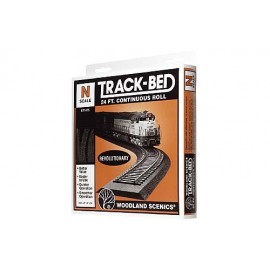
N Scale Trackbed Roll 24ft.
Price: £ 13.25Totally flat areas of land are very rare in nature. They usually occur as...
Related posts
-
 How to remove super glue (cyanoacrylate)?Cyanoacrylate is best known as super glue. The best way to remove it is with acetone or an acetone-based product...
 - How to clean model railways track?There is of course the old tried and tested method, the track rubber which does the job, no railway modeller should...
- How to weight my model so it does not tip?For wargaming figures, a small coin or washer glued to the under side of the base will usually to do the job. This...
- What are ejector pins?Ejector pins are used in the injection moulding process of the manufacturing of plastic kits and die cast kits. They...
- How do I know if my knife is blunt?You will be able to feel the blade dragging and resisting as you draw the knife over what it is you are trying to...