OO9 is 4mm to the foot scale (that is OO or 1/76) but using 9mm track gauge (the same size as N gauge). This is...

Cart 0 Product Products (empty)
No products
Free shipping! Shipping
£ 0.00 Total
Product successfully added to your shopping cart
Quantity
Total
There are 0 items in your cart. There is 1 item in your cart.
Total products (tax incl.)
Total shipping (tax excl.) Free shipping!
Total (tax incl.)
Search Tips
Tips categories
Latest Tips
-
 What is OO9?Read more
 -
 How can I best model a goods yard on my layout?Read more
Creating a goods yard on a model railway layout can add a lot of realism and operational interest. It's a great way...
-
 What are the main advantages of using a spray booth?Read more
A spray booth is a very useful tool for any regular airbrush user. An airbrush will use air pressure to atomise paint...
-
 How can you stop wheel slip?Read more
Wheel slip is not a problem that's unique to our model railway layouts, engineers in the real railway world often...
-
 How to weight my model so it does not tip?Read more
For wargaming figures, a small coin or washer glued to the under side of the base will usually to do the job. This...

What is OO9?
OO9 is 4mm to the foot scale (that is OO or 1/76) but using 9mm track gauge (the same size as N gauge). This is narrow gauge modelling and is meant to represent 2ft gauge in real life.
The name comes from OO scale and 9mm track.
It is a very similar scale to HOe which is HO narrow gauge, so 1/87 scale on 9mm track. Couplings are compatible between OO9 and HOe.
Narrow gauge railways were mostly found in industrial use, say for instance in a quarry. A few passengers trains also run on narrow gauge such as Lynton and Barnstaple railway or the Ffestiniog railway.
Click here to receive the tips weekly in your mailbox. You can unsubscribe at any time.
Related products
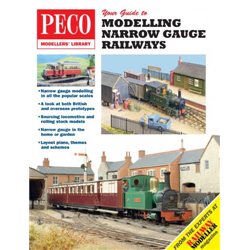
DISC**Your Guide To Narrow Gauge Railways
Price: £ 6.99Your Guide To Narrow Gauge Railways In full colour, with 120 pages, this is a...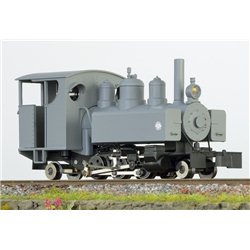
DISC**Baldwin 2-6-2 grey, closed cab
Price: £ 145.90Baldwin 2-6-2 Trench Train Locomotive, grey, closed cab Used to carry troops...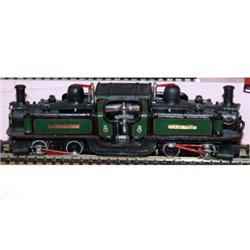
Festiniog double ended Fairlie - Unpainted
Price: £ 107.80Festiniog double ended Fairlie (OO/OO9 Scale 1/76th) Kit Includes valve gear,...
Related posts
-
 What scale is Hornby?Hornby model railways are OO Scale or 1/76th that is 4 millimetres to the foot (12 inches). It runs on a track with...
 - How to weight my model so it does not tip?For wargaming figures, a small coin or washer glued to the under side of the base will usually to do the job. This...
- Is Bachmann compatible with Hornby?Yes, any OO scale loco, wagon or coach will work on any OO scale track, regardless of brand. Couplings are also...
- What are the model railway eras?According to Bachmann, as it states in their catalogue there are 9 eras. As they say in their catalogue this is not...
- Can a "DCC ready" train be used on analogue?Yes, you can use a DCC ready train on your analogue layout. DCC ready just means that the train has been factory...