The dictionary defines gauge as "the distance between the two rails on a railway line" and scale as "the scale of a...

Cart 0 Product Products (empty)
No products
Free shipping! Shipping
£ 0.00 Total
Product successfully added to your shopping cart
Quantity
Total
There are 0 items in your cart. There is 1 item in your cart.
Total products (tax incl.)
Total shipping (tax excl.) Free shipping!
Total (tax incl.)
Search Tips
Tips categories
Latest Tips
-
 What is the difference between gauge and scale?Read more
 -
 What is a mitre box?Read more
A mitre box is a metal framework designed to hold an item of building material in place while you saw through it at...
-
 What is a BR Mk1 coach?Read more
The BR Mk1 coach (British Railways Mark 1) was a standard design of railway carriage introduced by British Railways...
-
 What is the difference between 00 and H0?Read more
If you have ever wondered into your local model shop to admire, dream about or even treat yourself to a 00 gauge...
-
 What is the best way to temporarily attach wagon loads?Read more
There are many ways to attach loads to your wagons: Blu Tack, double sided sticky tape and magnets are just a few,...

What is Thomas the Tank Engine?
Thomas the Tank Engine is a beloved British children's character who originated in a series of books titled The Railway Series, written by Reverend Wilbert Awdry. The character first appeared in 1946 and quickly became the most famous of all the engines featured in the stories. Set on the fictional Island of Sodor, the stories revolve around Thomas and his friends, who are all anthropomorphised locomotives with distinct personalities and roles on the railway. Thomas, a small blue tank engine with the number 1 painted on his side, is portrayed as a cheeky, hard-working, and eager engine, always striving to be a "really useful engine."
The charm of Thomas lies in his relatability and the life lessons subtly woven into each story. The books, and later the television series, often explore themes of friendship, responsibility, teamwork, and perseverance. Thomas’s adventures, whether involving a race against time, a challenging delivery, or helping a friend in need, are designed to impart moral values to young readers and viewers. Despite his occasional mistakes, Thomas always learns from his experiences, making him a character that children can both enjoy and learn from.
The transition from book to screen happened in 1984 when Thomas & Friends was first broadcast on ITV. The series was initially narrated by Ringo Starr, the former drummer of The Beatles, which added a unique touch of celebrity appeal. The show quickly became a staple of British children's television, known for its gentle pacing, engaging stories, and iconic theme music. Over the years, the show has evolved with new characters, locations, and updated animation, but it has always remained true to the spirit of the original books.
Thomas the Tank Engine's cultural impact extends far beyond books and television. He has become a global brand, with merchandise ranging from toys and clothing to theme parks and live shows. The character's appeal is universal, and his stories have been translated into numerous languages, reaching children across the world. Despite this international success, Thomas remains a quintessentially British character, deeply rooted in the traditions of the UK’s railway history.
The enduring popularity of Thomas the Tank Engine can be attributed to the timeless quality of the stories and the way they resonate with both children and adults. For older generations, there is a sense of nostalgia associated with Thomas, while for younger viewers, he represents a trusted and familiar friend. The combination of charming characters, gentle storytelling, and valuable life lessons ensures that Thomas the Tank Engine continues to be a beloved figure in children's entertainment.
In essence, Thomas the Tank Engine is more than just a children's character; he is a cultural icon who has brought joy and education to generations of children. His legacy is a testament to the power of storytelling and the enduring appeal of a small, cheeky engine who always tries his best.
Posted in: Model Railway
Click here to receive the tips weekly in your mailbox. You can unsubscribe at any time.
Related products
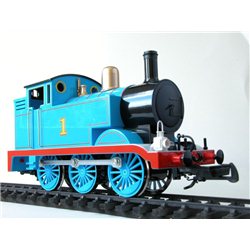
Parts to Convert the 'G' Scale Bachmann...
Price: £ 33.90Parts to Convert the 'G' Scale Bachmann 'THOMAS' into a Real Locomotive.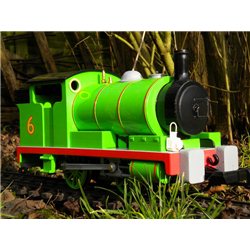
Parts to Convert the 'G' Scale Bachmann 'PERCY'...
Price: £ 45.90Parts to Convert the 'G' Scale Bachmann 'PERCY' into a Real Locomotive
Related posts
-
 What scale is Hornby?Hornby model railways are OO Scale or 1/76th that is 4 millimetres to the foot (12 inches). It runs on a track with...
 - How to weight my model so it does not tip?For wargaming figures, a small coin or washer glued to the under side of the base will usually to do the job. This...
- Is Bachmann compatible with Hornby?Yes, any OO scale loco, wagon or coach will work on any OO scale track, regardless of brand. Couplings are also...
- What are the model railway eras?According to Bachmann, as it states in their catalogue there are 9 eras. As they say in their catalogue this is not...
- Can a "DCC ready" train be used on analogue?Yes, you can use a DCC ready train on your analogue layout. DCC ready just means that the train has been factory...