Older locomotives and rolling stock may not be compatible with Code 55 N Gauge track. This is because Code 55 track...

Cart 0 Product Products (empty)
No products
Free shipping! Shipping
£ 0.00 Total
Product successfully added to your shopping cart
Quantity
Total
There are 0 items in your cart. There is 1 item in your cart.
Total products (tax incl.)
Total shipping (tax excl.) Free shipping!
Total (tax incl.)
Search Tips
Tips categories
Latest Tips
-
 Will older locomotives and rolling stock run on Code 55 N Gauge track?Read more
 -
 What is the colour of rust?Read more
The answer to the question "What is the colour of rust?" is more a tip about modelling in general than a lesson in...
-
 What is the best size wire to use on my layout?Read more
Wiring is sometimes a subject of wide debate amongst modellers. Each layout is unique with a wide range of aspects...
-
 Are building smoke generators different to locomotive ones?Read more
Building smoke generators are different from locomotive ones in two main areas, size and voltage.Smoke generators...
-
 How can I model decay on model roads?Read more
Making model roads is easy thanks to the range of products available that can be used to fashion a suitable road...

How do I model industries on my layout?
One of the most rewarding aspects of building a model railway is creating a realistic, living world in miniature. While laying track, wiring, and running trains is immensely satisfying, adding interactive industries and operational scenes can truly bring your layout to life. Modelling industries not only enhances the visual appeal but allows you to simulate real-world rail operations, making your layout a dynamic, ever-changing diorama.
To begin, research the types of industries that would have been served by rail in your chosen era and region. Common examples include coal mines, quarries, factories, warehouses, timber yards and goods depots. Study photographs and documentation to understand the typical structures, rolling stock, and operations associated with each industry.
When planning your industrial area's location, consider accessibility and sightlines. Situate it along a switched siding or tight-to-the-mainline branch for easy shunting movements. Use cameo cuts, duck-unders or removable segments to allow reach for coupling and uncoupling.
Construct your industrial structures from kits, scratch building or a mixture of both techniques. Add realistic details like weathering, signage, vehicles, and miniature workers to set the scene. Loads of coal, crates, barrels, and raw materials can be modelled from household items and modest scratchbuilding.
Once your structures are complete, incorporate operational possibilities by including rail-served loading docks, crane trackage, machinery to load and unload, and a mock run-around or cabmobility area. Design switching challenges like tight curvature, trapped or redundant spurs and interference from across-the-road obstacles.
Finally, devise operating sequences for your industrial area. Per the prototype, schedule arrivals and departures of commodities, maintenance of way activities, crew changes, and more. Develop a pool of civic workers, from section gangs to yardmasters, each with unique duties. Card-operating systems simulate real-world switch lists and timetables.
With diligent planning and execution, your model railway can accurately depict the symbiotic relationship between rails and industry. Operations bring the layout alive while double-heading switching maneuvers prove as engaging as watching a timefreight race across the main. Most importantly, modelling industries allows your skills as a railroader and storyteller to shine.
Posted in: Model Railway
Click here to receive the tips weekly in your mailbox. You can unsubscribe at any time.
Related products
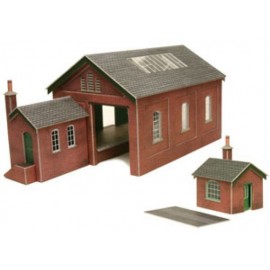
00 goods shed
Price: £ 16.00A strong and sturdy building OO Gauge Goods Shed with Weighbridge and...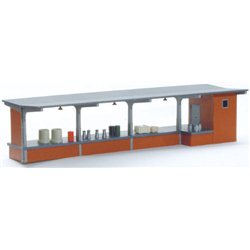
Goods Depot
Price: £ 18.10A plastic kit of a OO gauge goods depot / goods transfer facility. Supplied...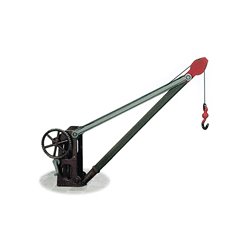
Goods yard crane, with fixed timber jib
Price: £ 9.75Goods yard crane, with fixed timber jib Moulded plastic parts that require...
Related posts
-
 What scale is Hornby?Hornby model railways are OO Scale or 1/76th that is 4 millimetres to the foot (12 inches). It runs on a track with...
 - How to weight my model so it does not tip?For wargaming figures, a small coin or washer glued to the under side of the base will usually to do the job. This...
- Is Bachmann compatible with Hornby?Yes, any OO scale loco, wagon or coach will work on any OO scale track, regardless of brand. Couplings are also...
- What are the model railway eras?According to Bachmann, as it states in their catalogue there are 9 eras. As they say in their catalogue this is not...
- Can a "DCC ready" train be used on analogue?Yes, you can use a DCC ready train on your analogue layout. DCC ready just means that the train has been factory...