A footplate is a footplate! or so you would think! The definition of a footplate in the dictionary is "the part of a...

Cart 0 Product Products (empty)
No products
Free shipping! Shipping
£ 0.00 Total
Product successfully added to your shopping cart
Quantity
Total
There are 0 items in your cart. There is 1 item in your cart.
Total products (tax incl.)
Total shipping (tax excl.) Free shipping!
Total (tax incl.)
Search Tips
Tips categories
Latest Tips
-
 What is a footplate?Read more
 -
 Why are ships' hulls painted red beneath the waterline?Read more
Painting ships' hulls red beneath the waterline serves a specific purpose and has been a longstanding tradition in...
-
 When and why would a railway modeller use a reed switch?Read more
As a modeller, but not necessarily an electrician, you may have read many 'how to' articles advising the use of a...
-
 Can a non DCC ready engine be converted to DCC?Read more
In theory, any analogue model railway locomotive can be converted to DCC, but instead of having a socket to plug a...
-
 What are Kadee couplings?Read more
Kadee couplings are a popular choice for railway modellers, particularly those modelling in HO and OO gauge....

How did train drivers read semaphore signals at night?
Semaphore signals were a common form of railway signalling before the advent of modern electronic signals. During the day, train drivers could easily see and interpret the position of the semaphore arms. However, reading semaphore signals at night presented a significant challenge.
To overcome this, a process called "lighting up" the signals was used. This involved the use of oil lamps or gas burners positioned behind the signal arms, some of which had coloured lenses. These lamps illuminated the signal arms, making them visible to train drivers during the night. The lamps were usually coloured to correspond with the different signal aspects, such as red for stop and green for clear.
To read the signals, train drivers would look for the position of the illuminated arms. For example, if the arm was horizontal, it indicated "danger" or "stop," while a raised arm at a 45-degree angle indicated "proceed with caution." By memorizing the different positions and colours of the semaphore arms, train drivers could safely navigate the railway network in the dark.
Posted in: Power and control
Click here to receive the tips weekly in your mailbox. You can unsubscribe at any time.
Related products
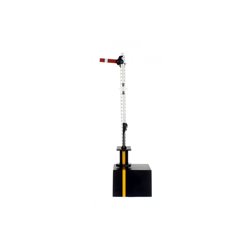
Motorised Signal LMS Home Steel Arm Single Post
Price: £ 64.70Motorised Signal LMS Home Steel Arm Single PostSmooth operating servo...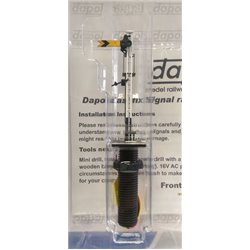
Related posts
-
 Can a "DCC ready" train be used on analogue?Yes, you can use a DCC ready train on your analogue layout. DCC ready just means that the train has been factory...
 - Is it difficult to fit a DCC decoder in to a DCC ready engine?In theory, it should be easy as the whole idea of being DCC Ready is to simplify the process. The first time I did...
- What is 7/0.2 wire?7/02 wire is a wire made of 7 strands of 0.2mm wire. Stranded wire has the advantage of being flexible while solid...
- Is an N Gauge controller compatible with OO Gauge?Yes, an N Gauge controller is compatible with OO gauge trains. You may have to change the power clip to the track...
- Is stranded wire better than solid wire?In my experience, stranded wire is preferable over solid wire. Stranded wire is more flexible than solid core wire,...