There is no definitive 'best' model railway track in OO gauge, as different modellers may have different preferences...

Cart 0 Product Products (empty)
No products
Free shipping! Shipping
£ 0.00 Total
Product successfully added to your shopping cart
Quantity
Total
There are 0 items in your cart. There is 1 item in your cart.
Total products (tax incl.)
Total shipping (tax excl.) Free shipping!
Total (tax incl.)
Search Tips
Tips categories
Latest Tips
-
 Which model railway track is the best one in OO gauge?Read more
 -
 What is the difference between a boat and a ship?Read more
Finding cut and dry, black or white or definitive rules that without doubt define a vessel as a boat or a ship is not...
-
 What are waterslide transfers?Read more
Waterslide transfers are a key component of scale modelling, allowing you to add intricate markings, insignias and...
-
 How do I test an engine without a controller?Read more
You do not always have a model railway controller on you. And even if you do, sometimes you do not have any power...
-
 Are surface mounted point motors better than under the baseboard ones?Read more
There is no one-size-fits-all answer to this question, as the choice between surface-mounted and under-baseboard...

What is a stay-alive?
A stay-alive (or keep-alive) is a capacitor that can be used with a DCC decoder. It stores power to allow for a more effective and constant power to your locomotive motor and therefore, smoother running.
However, there are issues with fitting the capacitor to the decoder chip: some soldering may be required and fitting the capacitor to smaller engines could be problematic due to lack of space inside. So, these things should be taken in to consideration before buying one.
Please note, some high-end DCC decoders are already fitted with a stay-alive.
Posted in: Power and control
Click here to receive the tips weekly in your mailbox. You can unsubscribe at any time.
Related products
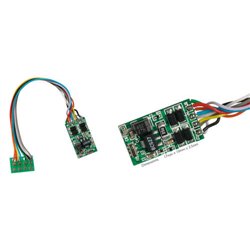
OMNI Decoder - 21 & 8 Pin Decoder
Price: £ 20.95OMNI Decoder - 21 & 8 Pin Decoder A really versatile decoder for use with...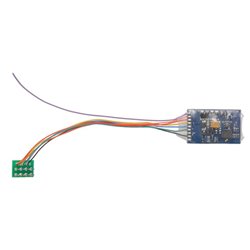
0.9 Amp 4 Function 8 Pin DCC Decoder featuring...
Price: £ 27.950.9 Amp 4 Function 8 Pin DCC Decoder featuring RailComPlus®
Related posts
-
 Can a "DCC ready" train be used on analogue?Yes, you can use a DCC ready train on your analogue layout. DCC ready just means that the train has been factory...
 - Is it difficult to fit a DCC decoder in to a DCC ready engine?In theory, it should be easy as the whole idea of being DCC Ready is to simplify the process. The first time I did...
- What is 7/0.2 wire?7/02 wire is a wire made of 7 strands of 0.2mm wire. Stranded wire has the advantage of being flexible while solid...
- Is an N Gauge controller compatible with OO Gauge?Yes, an N Gauge controller is compatible with OO gauge trains. You may have to change the power clip to the track...
- Is stranded wire better than solid wire?In my experience, stranded wire is preferable over solid wire. Stranded wire is more flexible than solid core wire,...