SPAD stands for Signal Passed At Danger. It is a term used in the railway industry to describe a situation where a...

Cart 0 Product Products (empty)
No products
Free shipping! Shipping
£ 0.00 Total
Product successfully added to your shopping cart
Quantity
Total
There are 0 items in your cart. There is 1 item in your cart.
Total products (tax incl.)
Total shipping (tax excl.) Free shipping!
Total (tax incl.)
Search Tips
Tips categories
Latest Tips
-
 In railways, what does the term 'SPAD' mean and could I incorporate this into my layout ?Read more
 -
 What is a Thompson bogie?Read more
Thompson bogies were the metal framework and suspension units that housed the wheelsets on Thompson railway coaches....
-
 What are my options for motorising a turntable on my layout?Read more
There are several options for motorising a turntable on a model railway layout, including:Manual operation: The most...
-
 What is a pinion gear on a model railway locomotive?Read more
A pinion gear (often called a pinion cog) is a small metal cog that can be found fitted to the shaft of a model's...
-
 Which is the best building kit for the beginner model to start with, plastic or card?Read more
When it comes to building kits for beginner model railway enthusiasts, both plastic and ready-cut and ready-printed...

In railways, what does the term 'SPAD' mean and could I incorporate this into my layout ?
SPAD stands for Signal Passed At Danger. It is a term used in the railway industry to describe a situation where a train passes a signal that is displaying a red aspect, indicating that the train should stop. SPADs are serious safety incidents and can have potentially dangerous consequences.
Usually, there are many SPAD incidents each year on the railways but the vast majority of incidents have no real cause for harm as they are generally the result of minor misjudgements of the distance to a signal and the necessary braking distance needed which can lead to minor overruns. Additionally, most overruns also occur at slow speeds.
There is a safety distance factored into the positioning of most signals which is referred to as the 'Safety Overlap'. The 'Safety Overlap' is a clear section of track approximately 183 metres in length and most minor overruns will safely come to a complete stop within this distance.
In some instances, last-chance warning signals have been installed reminding drivers of the need to stop. These are generally painted blue and have a three-aspect configuration with a red flashing light that can be activated when a driver passes a previous stop signal.
With an appropriate 'Safety Overlap' it is possible for modellers to incorporate specialist SPAD signals onto a layout in advance of points, crossovers and stations where they can warn drivers of potential dangers, adding an extra layer of realism to a layout.
Posted in: Model Railway
Click here to receive the tips weekly in your mailbox. You can unsubscribe at any time.
Related products
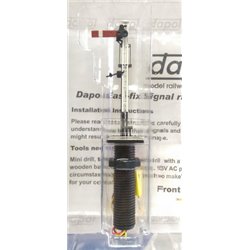
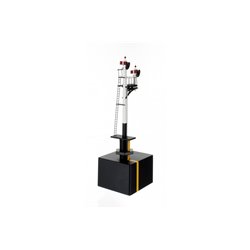
GWR Bracket Left Hand 1 Arm Signal
Price: £ 67.10GWR Bracket Left Hand 1 Arm Signal Dapols junction semaphore signals are easy...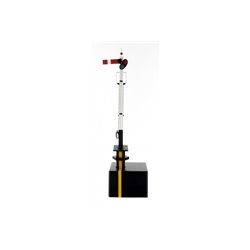
GWR Home Single Mast Motorised Signal (square...
Price: £ 64.70GWR Home Single Mast Motorised Signal (square post) Dapols O Gauge semaphore...
Related posts
-
 What scale is Hornby?Hornby model railways are OO Scale or 1/76th that is 4 millimetres to the foot (12 inches). It runs on a track with...
 - How to weight my model so it does not tip?For wargaming figures, a small coin or washer glued to the under side of the base will usually to do the job. This...
- Is Bachmann compatible with Hornby?Yes, any OO scale loco, wagon or coach will work on any OO scale track, regardless of brand. Couplings are also...
- What are the model railway eras?According to Bachmann, as it states in their catalogue there are 9 eras. As they say in their catalogue this is not...
- Can a "DCC ready" train be used on analogue?Yes, you can use a DCC ready train on your analogue layout. DCC ready just means that the train has been factory...