Felix Pole was an ambitious employee of the Great Western Railway. Born in 1877, by the age of 27 he was working in...

Cart 0 Product Products (empty)
No products
Free shipping! Shipping
£ 0.00 Total
Product successfully added to your shopping cart
Quantity
Total
There are 0 items in your cart. There is 1 item in your cart.
Total products (tax incl.)
Total shipping (tax excl.) Free shipping!
Total (tax incl.)
Search Tips
Tips categories
Latest Tips
-
 What is a Felix Pole wagon?Read more
 -
 Can I undercoat in black if I am going to paint white?Read more
Yes, you can use a black undercoat if you are painting something white but ideally you should look at using a white...
-
 How do you weather a model ship's decking?Read more
Weathering your ship's decking will provide spectacular results to the overall appearance of the model, especially if...
-
 What is a "helping hand" tool?Read more
Introducing the most useful piece of kit that any modeller could have in their toolbox. It is called a helping hand...
-
 What is code 83 track used for?Read more
Code 83 track is used to represent North American railway track prototypically used on main lines and for heavy...

What is a resin kit?
A resin kit is made from a liquid synthetic polyurethane resin, which is poured into a mould. Once it has set, the hardened model is removed from the mould revealing the model or model parts.
In my experience there is a bit more flash with resin kits but overall there is not much difference between the two, the detail is just the same, the painting is the same so no need for special paints.
Resin is considerably heavier than a conventional plastic kit and is usually used because it allows shorter runs by the manufacturer.
You will require a super glue (cynaoacrylate) or a two part epoxy glue for gluing parts together as plastic cements do not work on resin.
Posted in: Kit building
Click here to receive the tips weekly in your mailbox. You can unsubscribe at any time.
Related products
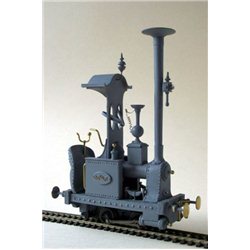
'Nellie' Gn15 Locomotive Body Kit
Price: £ 94.90The kit is complete except for paint, transfers and glue. The main body...
Related posts
-
 Do I need to wash my plastic kit?I personally wash all my plastic kits, I use warm soapy water (Washing up liquid) and a light rub over with a nail...
 - What is Milliput?Milliput is a two-part epoxy putty. There are two different colour rolls in a box when these are mixed together it...
- What modelling tools do I need to get started?Most modellers have an extensive tool kit, a tool for every eventuality. But when first starting a scalpel or a...
- How do I remove parts from the sprue?The short answer is carefully. The best way is with a sprue and plastic cutter but always be mindful of exactly...
- Do I need a cutting mat?It is not essential to have a cutting mat, but it is a good idea. It saves getting in trouble with your significant...