Peco's code 60 rails are used in the production of Z gauge model railway track, but they're also used to model the...

Cart 0 Product Products (empty)
No products
Free shipping! Shipping
£ 0.00 Total
Product successfully added to your shopping cart
Quantity
Total
There are 0 items in your cart. There is 1 item in your cart.
Total products (tax incl.)
Total shipping (tax excl.) Free shipping!
Total (tax incl.)
Search Tips
Tips categories
Latest Tips
-
 In model railways, what are code 60 rails used for?Read more
 -
 What is an isolating track section?Read more
An isolated track section is a section of model railway track that is physically connected to other tracks on a...
-
 What are the benefits of a multiple grit sanding stick?Read more
Inevitably in most modelling projects, there is a requirement for the clean-up of parts prior to assembly. This may...
-
 What are the best tools to cut wooden parts such as planks for a period ship ?Read more
Wooden parts supplied with some kits can be quite thick and can offer significant resistance when a standard hobby...
-
 Some paint varnishes are labelled as glaze and some as gloss. What is the difference between them?Read more
Glaze and gloss are both terms used in the world of finishes and coatings, but they have different meanings and...

Can I use WD-40 on my model railway locomotive?
Every toolbox has a can of WD-40 in it to rid the world of squeaks and loosen any stubborn nuts and bolts, so the temptation when your model locomotive develops a squeak or starts to run a little rough is to grab the can and get to work. This however would be ill-advised.
There are two main reasons why WD-40 would not be the best tool for the job. Firstly, it's too thick, WD40 is designed for tackling rusty hinges and other heavy-duty tasks, the oil is not suitable for the delicate cogs and shafts within your engine and the chances are it will not penetrate the smaller nooks and crannies that the oil needs to reach.
The second reason why WD-40 is not suitable, is that it's dispensed using a pressurised can spraying thousands of droplets of oil at once. Not forgetting that a model's motor only requires a single drop of oil in specific places, excess oil will get everywhere contaminating and perishing delicate plastics, and even worse, the oil could find its way onto the motor's windings which will fail to perform when covered in a gloopy oil.
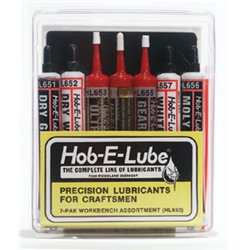
As good as WD-40 is, it's probably best to use a specialised oil and applicator when it comes to your pride and joy.
Click here to receive the tips weekly in your mailbox. You can unsubscribe at any time.
Related products
Related posts
-
 How to remove super glue (cyanoacrylate)?Cyanoacrylate is best known as super glue. The best way to remove it is with acetone or an acetone-based product...
 - What scale is Hornby?Hornby model railways are OO Scale or 1/76th that is 4 millimetres to the foot (12 inches). It runs on a track with...
- How to weight my model so it does not tip?For wargaming figures, a small coin or washer glued to the under side of the base will usually to do the job. This...
- What are ejector pins?Ejector pins are used in the injection moulding process of the manufacturing of plastic kits and die cast kits. They...
- Is Bachmann compatible with Hornby?Yes, any OO scale loco, wagon or coach will work on any OO scale track, regardless of brand. Couplings are also...