Understanding the names that manufacturers give specific collections within their range can be a little bewildering...

Cart 0 Product Products (empty)
No products
Free shipping! Shipping
£ 0.00 Total
Product successfully added to your shopping cart
Quantity
Total
There are 0 items in your cart. There is 1 item in your cart.
Total products (tax incl.)
Total shipping (tax excl.) Free shipping!
Total (tax incl.)
Search Tips
Tips categories
Latest Tips
-
 What is a Eduard ProfiPACK kit?Read more
 -
 Can I connect points, signals, lights and more to a DCC controller?Read more
Under the analogue system, modellers have become accustomed to wiring their light, signal and point motor circuits...
-
 What is a push-button switch?Read more
A push-button switch is a switch that you press to operate something opposed to other types which involve moving (or...
-
 Do I need to wash my plastic kit?Read more
I personally wash all my plastic kits, I use warm soapy water (Washing up liquid) and a light rub over with a nail...
-
 Why does my railway analogue controller keep cutting out?Read more
There are a few reasons why your analogue controller could be cutting out, but the most probable cause is a short...

What is a passing contact switch?
A passing contact switch differs from a conventional switch because it does not perform a simple on/off function, instead, its purpose is to supply a short sharp burst of power to any component that doesn't require a continuous power feed, for example, a point motor on a model railway layout.
From an operator's perspective, the switch works just the same as an ordinary toggle switch (by flicking it from side to side) and a burst of power is released through the circuit when the switch is half-way through its throw. This can understandably lead to concerns about whether the correct amount of power is being released if the switch is flicked too quickly or slowly, but this is not something to keep you awake at nights because the burst of electric doesn't control the points directly, it merely controls the polarity of magnets on the point motor, and it's those magnets that are the muscle for the point's movement.
Wiring the switch is simple enough, most passing contact switches have spade connectors on the back so you won't even need to solder. Basic passing contact switches usually only have three terminals on the back too, one for power in and two for power to be fed to the point motor so you shouldn't have any trouble installing one.
Posted in: Power and control
Click here to receive the tips weekly in your mailbox. You can unsubscribe at any time.
Related products
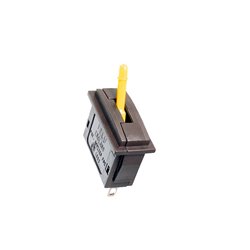
Yellow passing contact switch
Price: £ 11.30Passing contact switch with yellow lever. Provides the short burst of current...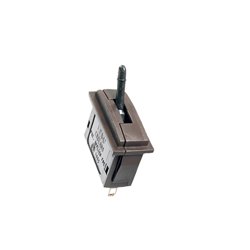
Black passing contact switch
Price: £ 11.30Passing contact switch with black lever. Provides the short burst of current...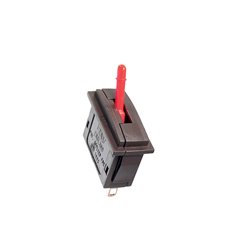
Passing contact switch red
Price: £ 11.30Passing contact switch with red lever. Provides the short burst of current...
Related posts
-
 Can a "DCC ready" train be used on analogue?Yes, you can use a DCC ready train on your analogue layout. DCC ready just means that the train has been factory...
 - Is it difficult to fit a DCC decoder in to a DCC ready engine?In theory, it should be easy as the whole idea of being DCC Ready is to simplify the process. The first time I did...
- What is 7/0.2 wire?7/02 wire is a wire made of 7 strands of 0.2mm wire. Stranded wire has the advantage of being flexible while solid...
- Is an N Gauge controller compatible with OO Gauge?Yes, an N Gauge controller is compatible with OO gauge trains. You may have to change the power clip to the track...
- Is stranded wire better than solid wire?In my experience, stranded wire is preferable over solid wire. Stranded wire is more flexible than solid core wire,...