One of the many advantages of using DCC is that compliant models are capable of operating auxiliary functions such as...

Cart 0 Product Products (empty)
No products
Free shipping! Shipping
£ 0.00 Total
Product successfully added to your shopping cart
Quantity
Total
There are 0 items in your cart. There is 1 item in your cart.
Total products (tax incl.)
Total shipping (tax excl.) Free shipping!
Total (tax incl.)
Search Tips
Tips categories
Latest Tips
-
 What are functions on a DCC decoder?Read more
 -
 What is the difference between model asphalt and tarmac?Read more
If you are installing model roads onto your diorama or layout, you may be wondering whether to use a product that...
-
 Can I mix code 100 and code 75 track sizes?Read more
For anybody who doesn't know the difference, code 100 track is the standard OO gauge model railway track. Code 75...
-
 What coarseness ballast should I use for my OO scale railway?Read more
Ballast comes in varying degrees in coarseness, fine medium and coarse. For OO scale the most realistic would have...
-
 How do I build a model railway in limited space?Read more
In the realm of model railways, enthusiasm often outstrips available space. But fear not! With careful planning and...

How wide should a layout be?
In theory, the only limit to the width of your layout is the amount of space you have available. The reality is slightly shorter: bear in mind that if you have a derailment you will need to be able to reach your locomotives, coaches and wagons.
If you have your layout against a wall, you do not want to be stretching over your layout which may lead to damaging your scenery.
For these reasons, the maximum width you can realistically reach safely is about a meter (a bit more than 3 feet). This means the maximum width of a layout should be about one meter.
Ideally, you need access to all parts of the layout. This is why many railway modellers choose to build their layout around a central well allowing them to sit in the centre of your layout.
Click here to receive the tips weekly in your mailbox. You can unsubscribe at any time.
Related products
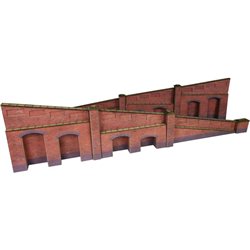
Tapered retaining wall in red brick
Price: £ 15.50Red brick sloping retaining walls for use with Metcalfe's PO244 (retaining...
Related posts
-
 Do I need to paint my base boards?I would recommend painting your base board for two reasons: The first being it will seal the base board and prevent...
 - Is static grass better than scatter?I use both, separately and together. Static grass comes in various sizes from 0.5mm to 12mm while scatter is...
- Do I need a respirator?If you are using an aerosol spray paint you should always use one. Always read the manufacturer’s...
- How to remove super glue (cyanoacrylate)?Cyanoacrylate is best known as super glue. The best way to remove it is with acetone or an acetone-based product...
- How do I apply static grass?Static grass is best applied using a static grass applicator. There are several on the market and they can apply...