Understanding the names that manufacturers give specific collections within their range can be a little bewildering...

Cart 0 Product Products (empty)
No products
Free shipping! Shipping
£ 0.00 Total
Product successfully added to your shopping cart
Quantity
Total
There are 0 items in your cart. There is 1 item in your cart.
Total products (tax incl.)
Total shipping (tax excl.) Free shipping!
Total (tax incl.)
Search Tips
Tips categories
Latest Tips
-
 What is a Eduard ProfiPACK kit?Read more
 -
 Can I connect points, signals, lights and more to a DCC controller?Read more
Under the analogue system, modellers have become accustomed to wiring their light, signal and point motor circuits...
-
 What is a push-button switch?Read more
A push-button switch is a switch that you press to operate something opposed to other types which involve moving (or...
-
 Do I need to wash my plastic kit?Read more
I personally wash all my plastic kits, I use warm soapy water (Washing up liquid) and a light rub over with a nail...
-
 Why does my railway analogue controller keep cutting out?Read more
There are a few reasons why your analogue controller could be cutting out, but the most probable cause is a short...

How wide are roads?
If you are modelling a road, you need to know how wide the real thing is so your model can be accurate.
Road widths were standardised in the UK in 1993 however there are still exceptions depending on specific circumstances such as having a wider road to allow heavy vehicles to turn.
A single lane is 12 feet (3.60 meters). This gives you a bit under 2 inches (5cm) in OO and 1 inch (2.5cm) in N gauge.
A street road where the road itself is used for pedestrians has a minimum width of 4.8 meters (15.75 ft). This equates to 2.5 inches (6.25cm) in OO gauge and 1.25in (3cm) in N gauge.
A single carriageway with 2 lanes will have a minimum width of 6 meters (about 20 feet). This means about 3 inches (8cm) in OO gauge and 1.5in (4cm) in N gauge.
Finally, a motorway with two lanes is 2x 7.3m (2x 24ft) plus the hard shoulder. This equates to nearly 2x 4in (2x 10cm) in OO gauge and 2x 2in (2x 5cm) in N gauge.
Please note that widths will also vary per country.
Click here to receive the tips weekly in your mailbox. You can unsubscribe at any time.
Related products
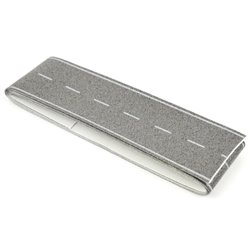
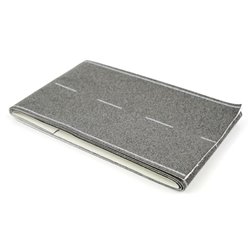
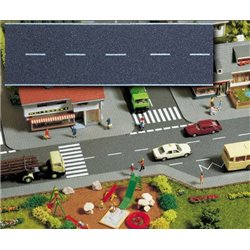
HO/OO Flexible Roadway 1m long
Price: £ 6.50HO/OO Flexible Roadway 1m long Flexible and self adhesive Paved Highway or...
Related posts
-
 Do I need to paint my base boards?I would recommend painting your base board for two reasons: The first being it will seal the base board and prevent...
 - Is static grass better than scatter?I use both, separately and together. Static grass comes in various sizes from 0.5mm to 12mm while scatter is...
- Do I need a respirator?If you are using an aerosol spray paint you should always use one. Always read the manufacturer’s...
- How to remove super glue (cyanoacrylate)?Cyanoacrylate is best known as super glue. The best way to remove it is with acetone or an acetone-based product...
- How do I apply static grass?Static grass is best applied using a static grass applicator. There are several on the market and they can apply...