A 1Co-Co1 wheel arrangement is essentially a Co-Co wheel arrangement with an unpowered, articulated pony truck...

Cart 0 Product Products (empty)
No products
Free shipping! Shipping
£ 0.00 Total
Product successfully added to your shopping cart
Quantity
Total
There are 0 items in your cart. There is 1 item in your cart.
Total products (tax incl.)
Total shipping (tax excl.) Free shipping!
Total (tax incl.)
Search Tips
Tips categories
Latest Tips
-
 What is a 1Co Co1 wheel arrangement?Read more
 -
 What advantages do starter or gift set models offer to a novice modelmaker?Read more
Starter or gift set models are a great option for novice modelmakers for several reasons. These sets are specifically...
-
 What model railway gauges are available?Read more
We often use terminology in the world of model railways interchangeably, when people ask about gauge, they are...
-
-43898-p.jpg "What is Peco Streamline?") What is Peco Streamline?Read more
What is Peco Streamline?Read morePeco Streamline is a range of model railway track that many modellers in the UK turn to when they want to take their...
-
 What is the difference between a primer and a surfacer?Read more
There are a large number of painting products on the market, each one claiming to be ideal in a particular situation....

What are 3 link couplings?
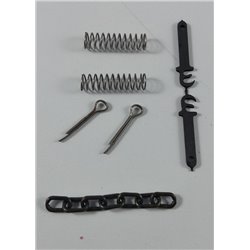
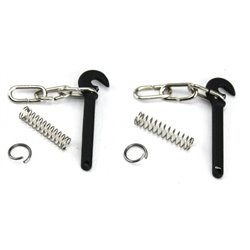
Three link couplings are exactly that: they are three links of chain that will connect your wagons.
These "loose" couplings were used in Britain on low speed trains till the 1970s. These trains did not have any automatic braking system and because of that, there was no pipe to be connected between wagons. The guard’s van at the back of the train was used to help control the train by keeping the couplings stretched.
Some model railway enthusiasts prefer the look of these couplings as they are as near to the real thing as you can get.
The couplings look great, the only drawback is the uncoupling process as it can prove to be a bit fiddly removing the chain link from the hook.
Most modellers have made their own uncoupling tool to alleviate this problem. Alternatively, you could use a small crochet hook rather than cobbling something together.
Click here to receive the tips weekly in your mailbox. You can unsubscribe at any time.
Related products
Related posts
-
 What scale is Hornby?Hornby model railways are OO Scale or 1/76th that is 4 millimetres to the foot (12 inches). It runs on a track with...
 - How to weight my model so it does not tip?For wargaming figures, a small coin or washer glued to the under side of the base will usually to do the job. This...
- Is Bachmann compatible with Hornby?Yes, any OO scale loco, wagon or coach will work on any OO scale track, regardless of brand. Couplings are also...
- What are the model railway eras?According to Bachmann, as it states in their catalogue there are 9 eras. As they say in their catalogue this is not...
- Can a "DCC ready" train be used on analogue?Yes, you can use a DCC ready train on your analogue layout. DCC ready just means that the train has been factory...