If you are soldering a white-metal kit together, you will need to use a lower temperature setting on your soldering...

Cart 0 Product Products (empty)
No products
Free shipping! Shipping
£ 0.00 Total
Product successfully added to your shopping cart
Quantity
Total
There are 0 items in your cart. There is 1 item in your cart.
Total products (tax incl.)
Total shipping (tax excl.) Free shipping!
Total (tax incl.)
Search Tips
Tips categories
Latest Tips
-
 What kind of solder should I use on white metal kits?Read more
 -
 What are 5 and 7 plank wagons?Read more
5 and 7 plank wagons are a type of railway wagon design dating back to the early 1900s. They are a simple design of...
-
 What model should I choose as a gift for someone?Read more
If you are wondering what model you should choose as a gift for someone, it would suggest two things, firstly, you...
-
 What is a diesel headcode?Read more
A diesel (or electric) locomotive's headcode was a four-digit code displayed on the front of the loco in the 1960s...
-
 Shunting yards: designing a track plan for realistic operationsRead more
A well-designed shunting yard can bring realism and operational interest to your model railway. Whether you're...

How long should my freight train be?
To model a freight train prototypically, one must first know how long the prototype is, but that information is difficult to come by as there is no set length.
That statement may not be helpful for modellers looking for a definitive answer, but 'there is no definitive answer' is the answer.
The shortest real-life freight train had just a single wagon, whereas the longest was an Australian BHP Iron Ore train weighing in at seven kilometres (4.5 miles) long and comprising 682 wagons. But tomorrow, that may change again.
If you're trying to determine how long your freight train should be, there usually has to be some modeller's compromise. Learn to trust your eye when constructing a train, if it's too short, it will appear so.
Another factor will be how much your locomotive can pull without its wheels slipping. The size of your layout will also have bearing because generally, modellers who get anywhere close to a realistically sized consist have incredibly generous baseboards, and operating such trains on a 4 x 6 board will only draw attention to its lack of size. So try to keep everything in perspective.
Mixed freight trains (or pick up goods) make excellent choices for modellers with little space to spare. That's because, although they were often fairly lengthy in real-life, by definition, they progressively lost parts of their consist the further into a journey or down a branch line they progressed, so we're used to seeing relatively short versions of such trains.
The flip side of the coin is the bulk movement of a single type of freight. These types of train would typically make the most of a single movement from supplier to distribution point, thus, such trains can be incredibly long and remain so for the entirety of the journey. For that reason, those types of trains are difficult to model with any great realism.
Whatever type of freight train you decide to model on your layout, a great tip to stop it looking too out of place is to use your platforms as reference. Your platforms are also likely to be undersized, so use them as a starting point to tie everything compromised together. If your freight train in real life fits into the platform of a station similar to one on your layout, then mirror this with the length of your train, likewise, a train that dwarfs a real platform will look just fine doing the same on the model.
Posted in: Model Railway
Click here to receive the tips weekly in your mailbox. You can unsubscribe at any time.
Related products
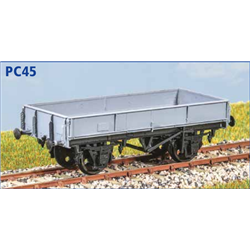
BR 13 ton Medium Goods Wagon (steel body)
Price: £ 16.304,000 of these wgons were built in 1950-55 to carry such loads as farm...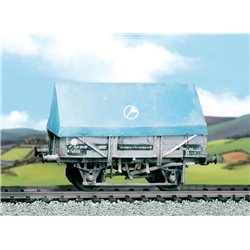
BR China Clayhood with hood fitted from 1973
Price: £ 16.70BR China Clayhood with hood fitted from 1973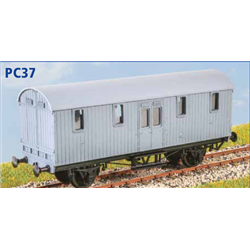
GWR Python Covered Carriage Truck - OO plastic kit
Price: £ 22.90GWR Python Covered Carriage Truck - OO unpainted plastic kitComes with metal...
Related posts
-
 What scale is Hornby?Hornby model railways are OO Scale or 1/76th that is 4 millimetres to the foot (12 inches). It runs on a track with...
 - How to weight my model so it does not tip?For wargaming figures, a small coin or washer glued to the under side of the base will usually to do the job. This...
- Is Bachmann compatible with Hornby?Yes, any OO scale loco, wagon or coach will work on any OO scale track, regardless of brand. Couplings are also...
- What are the model railway eras?According to Bachmann, as it states in their catalogue there are 9 eras. As they say in their catalogue this is not...
- Can a "DCC ready" train be used on analogue?Yes, you can use a DCC ready train on your analogue layout. DCC ready just means that the train has been factory...