A well-designed shunting yard can bring realism and operational interest to your model railway. Whether you're...

Cart 0 Product Products (empty)
No products
Free shipping! Shipping
£ 0.00 Total
Product successfully added to your shopping cart
Quantity
Total
There are 0 items in your cart. There is 1 item in your cart.
Total products (tax incl.)
Total shipping (tax excl.) Free shipping!
Total (tax incl.)
Search Tips
Tips categories
Latest Tips
-
 Shunting yards: designing a track plan for realistic operationsRead more
 -
 Can I use fibre optics as a single lighting solution for buildings and streetlamps on my layout?Read more
Yes, fibre optics can be used as a single lighting solution for buildings and streetlamps on a model railway layout....
-
 What is the smallest baseboard size for OO/HO gauge?Read more
Based on the principle of a layout configured as a loop the smallest practical baseboard size for an OO/HO will be 31...
-
 What is the difference between a train set and a layout?Read more
The knowledge that we acquire when building our model railway layouts leaves us with no doubt about the difference...
-
 How do I remove paint from a model?Read more
In the past some people have said to use oven cleaner to remove paint. I have found that this is quite an evasive...

What is the minimum space required to install an N gauge incline?
How much space is required to fit an incline onto an N gauge model railway depends on how high you want to raise the track, the higher the target, the greater the space required.
To help you calculate how much space is required for your project, you will need to look at what gradients are possible. On model railways, a gradient of 1 in 50 is what most modellers aim for. If you are considering a gradient steeper than this, be prepared for some compromise of traction or operational restrictions.
But assuming you don't want to push the boundaries, a 1 in 50 gradient simply means that for every centimetre you want your track to rise, a distance of 50 centimetres should be allowed to achieve it. The formula also works for inches if you prefer to use those, for every inch of rise, 50 inches of travel is needed.
A good example of the calculation in practice is when an N gauge track needs to rise to cross over another track. It will require raising approximately 5 cm, so simply take that height and multiply it by 50 to give the length of incline needed, in this case, 250 cm (2.5 m). But don't forget, you will need to allow for an additional 250 cm if you want the track to drop back to baseboard level on the other side!
Posted in: Model Railway
Click here to receive the tips weekly in your mailbox. You can unsubscribe at any time.
Related products
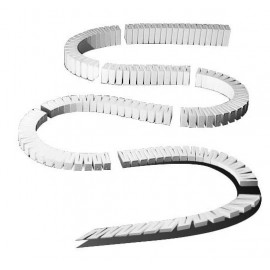
2% Foam Incline/Decline set - Pack of 8...
Price: £ 30.75Totally flat areas of land are very rare in nature. They usually occur as...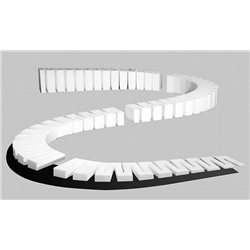
4% Foam Incline/Decline set - Pack of 4...
Price: £ 24.00Totally flat areas of land are very rare in nature. They usually occur as...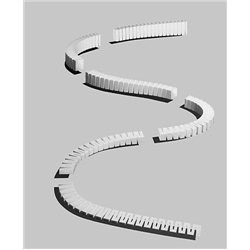
3% Foam Incline/Decline set - Pack of 6...
Price: £ 30.75Totally flat areas of land are very rare in nature. They usually occur as...
Related posts
-
 What scale is Hornby?Hornby model railways are OO Scale or 1/76th that is 4 millimetres to the foot (12 inches). It runs on a track with...
 - How to weight my model so it does not tip?For wargaming figures, a small coin or washer glued to the under side of the base will usually to do the job. This...
- Is Bachmann compatible with Hornby?Yes, any OO scale loco, wagon or coach will work on any OO scale track, regardless of brand. Couplings are also...
- What are the model railway eras?According to Bachmann, as it states in their catalogue there are 9 eras. As they say in their catalogue this is not...
- Can a "DCC ready" train be used on analogue?Yes, you can use a DCC ready train on your analogue layout. DCC ready just means that the train has been factory...