A footplate is a footplate! or so you would think! The definition of a footplate in the dictionary is "the part of a...

Cart 0 Product Products (empty)
No products
Free shipping! Shipping
£ 0.00 Total
Product successfully added to your shopping cart
Quantity
Total
There are 0 items in your cart. There is 1 item in your cart.
Total products (tax incl.)
Total shipping (tax excl.) Free shipping!
Total (tax incl.)
Search Tips
Tips categories
Latest Tips
-
 What is a footplate?Read more
 -
 Why are ships' hulls painted red beneath the waterline?Read more
Painting ships' hulls red beneath the waterline serves a specific purpose and has been a longstanding tradition in...
-
 When and why would a railway modeller use a reed switch?Read more
As a modeller, but not necessarily an electrician, you may have read many 'how to' articles advising the use of a...
-
 Can a non DCC ready engine be converted to DCC?Read more
In theory, any analogue model railway locomotive can be converted to DCC, but instead of having a socket to plug a...
-
 What are Kadee couplings?Read more
Kadee couplings are a popular choice for railway modellers, particularly those modelling in HO and OO gauge....

What are shunting signals?
Shunting signals are a type of railway signal that are commonly found in sidings and alongside regular signals. They are used in the same way as regular signals i.e. to authorise drivers to proceed, the difference being, the line ahead may not be clear of stationary traffic or obstruction.
Shunting signals are mostly used in situations where locomotives or trains need to manoeuvres onto a section or block of track that is not clear. This typically means places like sidings and stations where locomotives make shunting movements but they can be found at some crossovers and turnouts on the mainline too.
When a shunting signal gives permission, a driver may proceed, even if it's attached to a main signal showing red, however, because it's a shunting signal that's given the permission, the driver will be aware that they're not proceeding into a clear block of track and their route is set to direct the engine to a siding, awaiting rolling stock or a shunt limit.
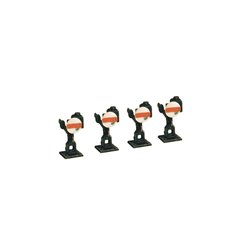
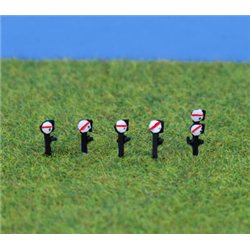
Modern shunting signals are made up of three signal lights arranged in a triangle while older versions appear as a smaller version of a semaphore signal or a disc that rotates. Shunting signals are a common sight on Britain's railways the majority of which are placed at ground level so are easy to spot.
Click here to receive the tips weekly in your mailbox. You can unsubscribe at any time.
Related products
Related posts
-
 Do I need a respirator?If you are using an aerosol spray paint you should always use one. Always read the manufacturer’s...
 - How to remove super glue (cyanoacrylate)?Cyanoacrylate is best known as super glue. The best way to remove it is with acetone or an acetone-based product...
- What is the best wood for baseboards?The most common wood for baseboards is probably chipboard as this is relatively inexpensive. Plywood is another...
- How do I stick parts together for a test fit?There are several trains of thought on the best way to secure parts together temporarily. Some suggest using a small...
- How to clean model railways track?There is of course the old tried and tested method, the track rubber which does the job, no railway modeller should...