A boxfile layout is a creative and compact way to build a model railway within the confines of a standard box file,...

Cart 0 Product Products (empty)
No products
Free shipping! Shipping
£ 0.00 Total
Product successfully added to your shopping cart
Quantity
Total
There are 0 items in your cart. There is 1 item in your cart.
Total products (tax incl.)
Total shipping (tax excl.) Free shipping!
Total (tax incl.)
Search Tips
Tips categories
Latest Tips
-
 What is a boxfile layout?Read more
 -
 In model railways, what does digital mean?Read more
The word 'digital' when used in model railways usually refers to a model or product being specifically manufactured...
-
 What is a Thompson bogie?Read more
Thompson bogies were the metal framework and suspension units that housed the wheelsets on Thompson railway coaches....
-
 How do you design a track plan?Read more
There are several different ways to design a track plan for your model railway project. There is no right or wrong...
-
 How to connect power across mobile baseboard section?Read more
There are a number of reasons modellers will need to create a layout in sections, some may desire a transportable...

What is a bubble car?
Bubble cars were a single-unit first generation DMU built by British Rail in the late 1950s and 1960. Because they had a cab for the driver at each end, they could be used singularly on lightly used branch lines or coupled to other DMUs or trailing cars to form larger trains. They are particularly popular with modellers due to their short length making them credible options for smaller layouts.
The name 'bubble car' was initially a nickname given to the units by enthusiasts, however, the name was eventually officially adopted by some later operators of the units.
There are two classes of bubble cars (Class 121 and 122) which aesthetically appear similar to each other. However, the class 121s have a head-code box above their centre cab window while the class 122s only have a small destination display.
The Class 122s were the first to be produced by the Gloucester RC&W in 1958. They were put to use mainly on the London - Midland region with a small number finding a home in Scotland operating services between Dundee and Arbroath, the Scottish units were later converted to Class 131 parcels units and enjoyed a prolonged life hauling mail.
The Class 121s were built a couple of years later in 1960 by the Pressed Steel Company. They were put to work on the Western Region and could frequently be seen operating services on Cornish branch lines, Thames Valley services and the Greenford branch in West London.
Class 121s saw regular service right up until 2017 giving them the title of the longest surviving first-generation DMUs in the country. After privatisation, they were utilised on daily services by Silverlink, Arriva Trains Wales and Chiltern Railways. Even today they can occasionally be seen out on the mainline all be it in disguise as Network Rail's departmental Class 960 and no longer on revenue-earning duties.
Click here to receive the tips weekly in your mailbox. You can unsubscribe at any time.
Related products
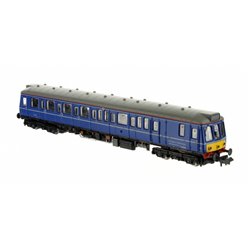
DISC**Class 121 121020 Chiltern Railways Blue
Price: £ 140.00Class 121 121020 Chiltern Railways Blue The Dapol Model of the 121 features:...
Class 122 BR Green with Whiskers
Price: £ 145.00-
Class 121 W 55028 Green Small Yellow
Price: £ 60.95
Related posts
-
 What scale is Hornby?Hornby model railways are OO Scale or 1/76th that is 4 millimetres to the foot (12 inches). It runs on a track with...
 - How to weight my model so it does not tip?For wargaming figures, a small coin or washer glued to the under side of the base will usually to do the job. This...
- Is Bachmann compatible with Hornby?Yes, any OO scale loco, wagon or coach will work on any OO scale track, regardless of brand. Couplings are also...
- What are the model railway eras?According to Bachmann, as it states in their catalogue there are 9 eras. As they say in their catalogue this is not...
- Can a "DCC ready" train be used on analogue?Yes, you can use a DCC ready train on your analogue layout. DCC ready just means that the train has been factory...