Creating a snowy scene on your layout is unfortunately not as simple as scattering some scenic snow on your tracks....

Cart 0 Product Products (empty)
No products
Free shipping! Shipping
£ 0.00 Total
Product successfully added to your shopping cart
Quantity
Total
There are 0 items in your cart. There is 1 item in your cart.
Total products (tax incl.)
Total shipping (tax excl.) Free shipping!
Total (tax incl.)
Search Tips
Tips categories
Latest Tips
-
 How do you create snow on a layout?Read more
 -
 How do I glue plastic models to a diorama covered in scatter?Read more
Deciding which glue to use when attaching plastic models to a baseboard is tricky enough at the best of times, but...
-
 How to use a track gauge like Peco SL-36 and SL-336?Read more
Track gauges of this type don't look like much when you take them out of the box and it's often hard to see how to...
-
 Where should I install a siding on my layout ?Read more
A siding is a very useful feature to have on a model railway layout. It provides a designated area for trains to be...
-
 What is T gauge in model railways?Read more
T gauge is the smallest commercially available model railway gauge. It has a scale of either 1:450 or 1:480 and a...

Do I have to use the track mat that came with my train set?
You do not have to use the track mat supplied with a starter set, ultimately, it's your layout and how you play with it is up to you.
What a track mat does do is protect your models from accumulating dust, fluff and debris from the carpet which over time can affect the running of the motor. A track mat will also show you what it is possible to achieve in a relatively small space. The track sections and buildings printed on a track mat are the same sizes as the full-size models that you can place on them, so they provide an excellent track plan for anyone without their own ideas.
There is no written rule to say you should or shouldn't use a track mat either on or off a baseboard. But how about using one to start with when you haven't a lot of track or buildings to provide scenery and replacing it as your collection grows with a more permanent structure?
Posted in: Model Railway
Click here to receive the tips weekly in your mailbox. You can unsubscribe at any time.
Related products
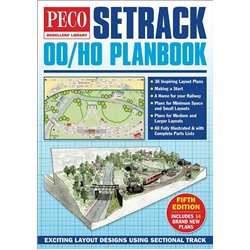
OO/HO Setrack Planbook 5th Edition
Price: £ 3.75This book is the new edition of a PECO bestseller and includes lots of new...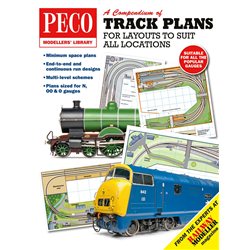
Track Plans For Layouts To Suit All Locations
Price: £ 3.95Track Plans For Layouts To Suit All Locations. This 62 page perfect-bound...
Related posts
-
 What scale is Hornby?Hornby model railways are OO Scale or 1/76th that is 4 millimetres to the foot (12 inches). It runs on a track with...
 - How to weight my model so it does not tip?For wargaming figures, a small coin or washer glued to the under side of the base will usually to do the job. This...
- Is Bachmann compatible with Hornby?Yes, any OO scale loco, wagon or coach will work on any OO scale track, regardless of brand. Couplings are also...
- What are the model railway eras?According to Bachmann, as it states in their catalogue there are 9 eras. As they say in their catalogue this is not...
- Can a "DCC ready" train be used on analogue?Yes, you can use a DCC ready train on your analogue layout. DCC ready just means that the train has been factory...