There is no one-size-fits-all answer to this question, as the choice between surface-mounted and under-baseboard...

Cart 0 Product Products (empty)
No products
Free shipping! Shipping
£ 0.00 Total
Product successfully added to your shopping cart
Quantity
Total
There are 0 items in your cart. There is 1 item in your cart.
Total products (tax incl.)
Total shipping (tax excl.) Free shipping!
Total (tax incl.)
Search Tips
Tips categories
Latest Tips
-
 Are surface mounted point motors better than under the baseboard ones?Read more
 -
 How do I attach a horse and rider figure to my layout?Read more
There are a number of different options for attaching figures such as a horse and rider to a layout. Perhaps the...
-
 What is a Wickham Trolley?Read more
A Wickham Trolley is a small railway maintenance vehicle once widely used across Britain's railways. Built by D...
-
 How much weight should I add to my rolling stock?Read more
We have all been there, with that wagon or coach that derails all of the time, and we suspect that the reason for...
-
 When painting models, what is the toothpaste technique?Read more
The toothpaste technique is very similar to the hairspray chipping technique and achieves roughly the same...

How much weight should I add to my rolling stock?
We have all been there, with that wagon or coach that derails all of the time, and we suspect that the reason for this mischievous item of rolling stock constantly making a break for freedom is a lack of weight. The solution is easy though: simply add more, but how much is too much?
To start with, you should take a little bit of time to think about the environment in which your trains operate. When you increase the weight of a wagon or coach, it will amplify the forces on the train as a whole. This will be most noticeable on tighter curves, complicated junctions and anywhere there is a gradient. If your engine has to cope with too much weight under these circumstances, it may well start to slip or in the worst case scenario, the train could derail. So too much weight is probably not advisable if your layout is particularly complex.
Next, you should think about the wagon or coach that you are preparing to add weight to. A much overlooked consideration is how freely it runs: if the wheels are a little stiff to begin with, then adding too much weight can amplify the already undesirable effect of the vehicle pulling back on the train which can cause problems especially on points.
If however, you are confident that the rolling stock is in great condition and can cope with the extra weight, and your track layout will accommodate heavy consists, then a rough rule of thumb is that you can pretty much double the weight of a particularly light piece of rolling stock. This will be more than enough to provide significant downforce to your model without causing too much trouble. In most cases though, it will not even be necessary to go that far, especially as there's a trade-off between having nicely weighted rolling stock and having trains that your engine can actually haul. So the best advice is to add a little bit at a time to find the optimum weight.
A top tip to save you having to take your model to pieces several times while you experiment is to try temporarily taping weights (or a spare track rubber) to the outside of your model to assess the effects before you apply a permanent solution. But should you try this, watch out for tunnels!
Click here to receive the tips weekly in your mailbox. You can unsubscribe at any time.
Related products
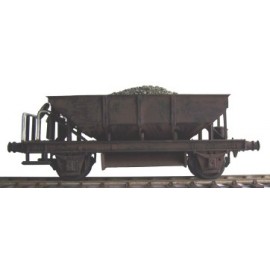
Dogfish 24ton Ballast Hopper Wagon kit
Price: £ 11.40Dogfish 24ton Ballast Hopper Wagon - OO unpainted plastic kit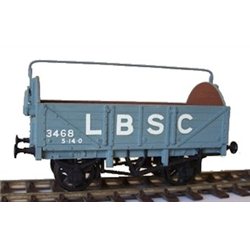
LBSC/SR 5 planks Open Wagon OO unpainted...
Price: £ 10.50LBSC 5 planks round or flat end open wagon plastic kit (unpainted)
Related posts
-
 What scale is Hornby?Hornby model railways are OO Scale or 1/76th that is 4 millimetres to the foot (12 inches). It runs on a track with...
 - How to weight my model so it does not tip?For wargaming figures, a small coin or washer glued to the under side of the base will usually to do the job. This...
- Is Bachmann compatible with Hornby?Yes, any OO scale loco, wagon or coach will work on any OO scale track, regardless of brand. Couplings are also...
- What are the model railway eras?According to Bachmann, as it states in their catalogue there are 9 eras. As they say in their catalogue this is not...
- Can a "DCC ready" train be used on analogue?Yes, you can use a DCC ready train on your analogue layout. DCC ready just means that the train has been factory...