The Craftsman Series by Wills Kits is a range of high-quality model railway kits in OO/HO gauge, designed for...

Cart 0 Product Products (empty)
No products
Free shipping! Shipping
£ 0.00 Total
Product successfully added to your shopping cart
Quantity
Total
There are 0 items in your cart. There is 1 item in your cart.
Total products (tax incl.)
Total shipping (tax excl.) Free shipping!
Total (tax incl.)
Search Tips
Tips categories
Latest Tips
-
 What is the Craftsman Series by Wills Kits?Read more
 -
 What is best flexible track or set track?Read more
It is not really a question of which track is best when it comes to a comparison between flexible track and set...
-
 What is live steam?Read more
Live steam refers to miniature, working models of steam-powered vehicles, such as locomotives, boats, and stationary...
-
 How do I create realistic flesh colours?Read more
There are many paint manufacturers who make flesh tone paints, all of which give a human look to your figures. I...
-
 What are my options for motorising a level crossing on my layout ?Read more
Motorising a level crossing can add a realistic touch to the operation of a layout. There are several options...

What are the white discs for on the front of steam trains?
The white discs that were displayed on the front of steam trains and early types of diesel were a way of communicating to the signal box what type of train it was and sometimes the route that it should take.
The white disc system is also known as the headcode and was introduced as early as 1850. Originally oil lamps painted white (to make them visible during daylight) and later white discs were placed in different positions on the front of locomotives to show what kind of train it was. This was important information for signalmen because back then trains were allowed to follow each other along the track using only a timed gap between them before the all-clear was given, so a signalman would leave a bigger gap after a slow train, for example, a heavy freight, so that the following train wouldn't catch it up and crash into the back of it. The system had obvious flaws but in the early days, it was all they had.
Eventually, the block system was introduced to the railways but the practice of using headcodes remained because although signalmen no longer needed to separate different types of train by a timed gap, they still found the information useful so that they could easily prioritise more important trains.
The exception to the rule was in the South of England where timetables were intense and junctions complex. Here it was felt that the use of headcodes would be more beneficial indicating a train's route so a six lamp/disc system was used.
During this period some companies had adopted their own versions of the system. However, this caused confusion when trains ventured into neighbouring regions so the Railway Clearing House initiated a simpler standard system. The system still used headcodes but restricted their use and potential combinations to just four lamps or discs, not surprisingly though, the South retained their route indication system.
The system was further simplified with the grouping of the big four in 1923, this time reducing the number of lamps or discs used to just two, this was again to apply to all but the South to best use the system in its respective environment.
The practice of using headcode discs and lamps continued into dieselisation. However, the system was eventually replaced with a four-digit code to indicate a train's combined type and route. Changing the system halfway through the production build of several early diesel designs resulted in many classes sporting different front end designs with some having discs whilst others had a route indicator box. This is most evident on the classes 20, 24, 31 and 40.
Click here to receive the tips weekly in your mailbox. You can unsubscribe at any time.
Related products
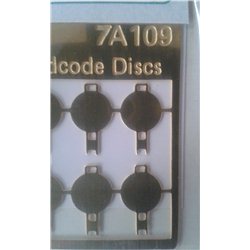
DISC**SR Headcode Discs
Price: £ 3.60SR Headcode Discs Etched Brass. 8 headcode discs per fret. Includes fold-up...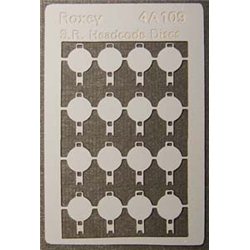
DISC**SR locomotive Headcode Discs
Price: £ 2.60SR locomotive Headcode Discs Etched Brass 16 Discs per fret Includes carrying...
Related posts
-
 Do I need a respirator?If you are using an aerosol spray paint you should always use one. Always read the manufacturer’s...
 - How to remove super glue (cyanoacrylate)?Cyanoacrylate is best known as super glue. The best way to remove it is with acetone or an acetone-based product...
- What is the best wood for baseboards?The most common wood for baseboards is probably chipboard as this is relatively inexpensive. Plywood is another...
- How do I stick parts together for a test fit?There are several trains of thought on the best way to secure parts together temporarily. Some suggest using a small...
- How to clean model railways track?There is of course the old tried and tested method, the track rubber which does the job, no railway modeller should...