A headcode box (also known as a route indicator or train reporting box) is a display unit mounted on the front of...

Cart 0 Product Products (empty)
No products
Free shipping! Shipping
£ 0.00 Total
Product successfully added to your shopping cart
Quantity
Total
There are 0 items in your cart. There is 1 item in your cart.
Total products (tax incl.)
Total shipping (tax excl.) Free shipping!
Total (tax incl.)
Search Tips
Tips categories
Latest Tips
-
 What is a headcode box?Read more
 -
 How do I clean super glue (cyanoacrylate)?Read more
Fortunately these days there are special products to help you remove any little super glue (cyanoacrylate) mistakes...
-
 What is the significance of the 'Vintage Classics' label on some Airfix kits?Read more
The 'Vintage Classics' label on some Airfix kits signifies that these particular kits are re-releases of older,...
-
 Were brake vans always positioned at the rear of a rake?Read more
Brake vans, also known as guards' vans or brake coaches, were typically positioned at the rear of a rake of wagons or...
-
 How do I stop paint from bleeding under masking tape?Read more
When painting a model it is always possible that paint can seep underneath masking tape and thus ruin the painting...

What is a Co-Co wheel arrangement?
There are many variations of wheel arrangements for diesel and electric locomotives just as there were with steam locos, and for the same reasons: to facilitate different power outputs and distribute the weight of an engine. These arrangements have been allocated codes to make them easily identifiable.
Co-Co refers to a locomotive with a single bogie attached to each end, each bogie has 6 wheels attached to it (3 on the left side and 3 on the right). This means that the locomotive has 12 wheels in total. On a Co-Co locomotive, each wheel has its own traction motor resulting in all of the wheels being powered.
Locomotives with a Co-Co wheel arrangement are very good at hauling thanks to their all-wheel drive and often have a favourable route availability due to the weight of the locomotive being distributed through 12 wheels. The latter is the reason why more diesel locomotives have Co-Co wheel arrangements than electrics as these tend to be much lighter, therefore, negating the need to distribute their weight.
There have been a few classes of locomotive that due to their immense weight have needed their weight distributing beyond the capabilities of a Co-Co bogie. This was done by adding an additional two-wheeled, unpowered bogie to each end of the locomotive. This new configuration was given the code 1 Co-Co 1. Locomotives that adopted this configuration include the British Class 40 and Peak classes 44, 45 and 46.
Posted in: Model Railway
Click here to receive the tips weekly in your mailbox. You can unsubscribe at any time.
Related products
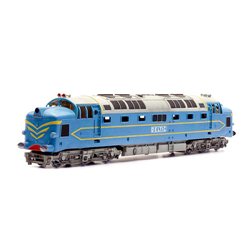
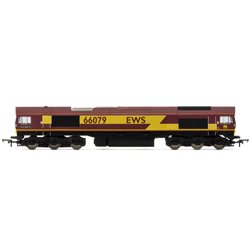
Co-Co Diesel EWS 'James Nightall GC' '66079'...
Price: £ 89.99Co-Co Diesel EWS 'James Nightall GC' '66079' Class 66
Related posts
-
 What scale is Hornby?Hornby model railways are OO Scale or 1/76th that is 4 millimetres to the foot (12 inches). It runs on a track with...
 - How to weight my model so it does not tip?For wargaming figures, a small coin or washer glued to the under side of the base will usually to do the job. This...
- Is Bachmann compatible with Hornby?Yes, any OO scale loco, wagon or coach will work on any OO scale track, regardless of brand. Couplings are also...
- What are the model railway eras?According to Bachmann, as it states in their catalogue there are 9 eras. As they say in their catalogue this is not...
- Can a "DCC ready" train be used on analogue?Yes, you can use a DCC ready train on your analogue layout. DCC ready just means that the train has been factory...