T-Gauge is the smallest commercially available model railway gauge in the world, with a track width of just 3 mm....

Cart 0 Product Products (empty)
No products
Free shipping! Shipping
£ 0.00 Total
Product successfully added to your shopping cart
Quantity
Total
There are 0 items in your cart. There is 1 item in your cart.
Total products (tax incl.)
Total shipping (tax excl.) Free shipping!
Total (tax incl.)
Search Tips
Tips categories
Latest Tips
-
 What is T-Gauge?Read more
 -
 How do I stop paint from bleeding under masking tape?Read more
When painting a model it is always possible that paint can seep underneath masking tape and thus ruin the painting...
-
 What size thread should I use for the rigging on a 1:350 scale model ship ?Read more
When it comes to rigging a 1:350 scale model ship, it is important to choose the right size thread to ensure accuracy...
-
 How to weight my model so it does not tip?Read more
For wargaming figures, a small coin or washer glued to the under side of the base will usually to do the job. This...
-
 How can I create realistic corrugated roofs for buildings?Read more
A number of model manufacturers produce materials to help modellers scratch-build scene elements to add further...

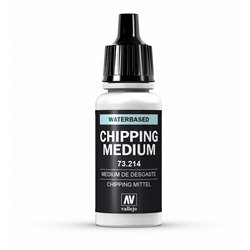
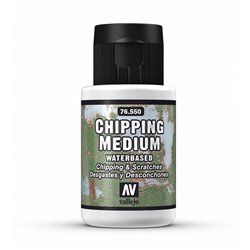
What is chipping medium?
Chipping medium is a weathering agent that creates chipped surfaces to give a more realistic look to your models.
It can be added to vehicles or door edges or in fact anywhere that you would expect to find areas of chipped paint.
It is very easy to use and will give a professional look to your model.
Simply wash your model as you would do normally with warm soapy water, and add a coat of primer, once dry add your base coat. Allow to dry.
Then add the chipping medium to the areas of the model that you want to appear chipped.
When this is dry, add your topcoat of paint.
When this has dried, wet the areas to be chipped with water and with a cocktail stick/toothpick scratch away the paint, the more you scratch the bigger the area will appear.
So for vehicles that have stone chips on their bonnets you will only need to scratch slightly to create the effect; for door edges you may want to scratch a larger area to give the appearance of constant use.
Once you are happy with the finish, add a coat of varnish to seal.
Posted in: Painting
Click here to receive the tips weekly in your mailbox. You can unsubscribe at any time.
Related products
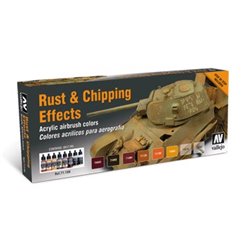
Model Air Set - Rust and Chipping Effects (x8)
Price: £ 23.99Model Air Set - Rust and Chipping Effects (x8)
Related posts
-
 Do I need to use a primer?For best results it is advisable to use a primer as this will stick to the plastic and give a uniform coat of paint...
 - What is weathering?Weathering is a painting technique used by modellers to create the appearance of dirt and grime and even damage to...
- How do I clean brushes used with enamel paint?Enamel paint is solvent based, so trying to wash in water will not work, you need to use white spirit. It is...
- How do I fill holes in a model?There are many products on the market for filling holes: There are plastic putties straight out of the tube, there...
- What is the best size paintbrush?This would depend on what you are painting as paint brushes come in various shapes and sizes. I would say for...