Decoders are definitely not all the same, they have different numbers of pins, can control different functions, come...

Cart 0 Product Products (empty)
No products
Free shipping! Shipping
£ 0.00 Total
Product successfully added to your shopping cart
Quantity
Total
There are 0 items in your cart. There is 1 item in your cart.
Total products (tax incl.)
Total shipping (tax excl.) Free shipping!
Total (tax incl.)
Search Tips
Tips categories
Latest Tips
-
 When choosing a DCC decoder, how important is the amp rating?Read more
 -
 What is the purpose of the trackmat system by Hornby?Read more
The purpose of the trackmat system by Hornby is to provide a convenient and easy-to-use solution for model railway...
-
 What tool is good for removing accumulated paint from an airbrush?Read more
Like many painting tools, airbrushes will periodically need a deep clean in order to remove persistent and ingrained...
-
 Where would I install a catchpoint on my layout and what are they used for?Read more
A catch point is a safety device used to prevent runaway trains from entering a section of track where they are not...
-
 Should I include a brake van on every train hauling goods wagons on my layout?Read more
Including a brake van on every train hauling goods wagons on a layout is not necessary, but it can add a realistic...

What is an end to end layout?
When most people think of a model railway, they think of an oval where the train can go around and round.
With an end to end layout, as the name suggests, the train runs from one end of the layout to the other and back again.
This is a good way to have a model railway if you have limited space and want to still be able to enjoy the hobby. The layout will fit on a shelf virtually anywhere.
If you think of most preserved steam railways, they are end to end showing just a portion of their former glory.
You can create this in model form, and it doesn’t have to be just a length of track going from point A to point B, you can incorporate as much or as little as you want.
There are many options when it comes to end to end layouts, you could add a shunting yard with several spurs for industrial or commercial loads or even your rakes of different coaches.
You could also add a goods yard and station mid-point and engine sheds for your locos at the other end with a turntable.
The options are endless.
Click here to receive the tips weekly in your mailbox. You can unsubscribe at any time.
Related products
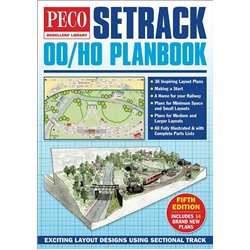
OO/HO Setrack Planbook 5th Edition
Price: £ 3.75This book is the new edition of a PECO bestseller and includes lots of new...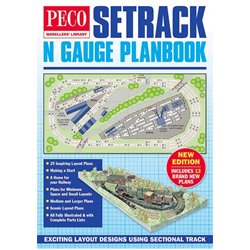
Related posts
-
 Do I need to paint my base boards?I would recommend painting your base board for two reasons: The first being it will seal the base board and prevent...
 - How do I apply static grass?Static grass is best applied using a static grass applicator. There are several on the market and they can apply...
- What is a Diorama?A diorama is three-dimensional scene creating a moment in time, this could be a historical event or a fictional one,...
- What is the best wood for baseboards?The most common wood for baseboards is probably chipboard as this is relatively inexpensive. Plywood is another...
- How to make hills?You can make hills in a variety of ways. The tried and tested way is with chicken wire and papier mache. This is a...