There are figures on the market designed purely for populating coaches. The ones that spring to mind are the Noch...

Cart 0 Product Products (empty)
No products
Free shipping! Shipping
£ 0.00 Total
Product successfully added to your shopping cart
Quantity
Total
There are 0 items in your cart. There is 1 item in your cart.
Total products (tax incl.)
Total shipping (tax excl.) Free shipping!
Total (tax incl.)
Search Tips
Tips categories
Latest Tips
-
 What are the best figures to populate my coaches?Read more
 -
 Should I add weight to my empty rolling stock to help them run smoother and avoid derailing?Read more
Adding weight to empty rolling stock can help to improve their running smoothness and reduce the risk of derailing on...
-
 What is modern image in model railways?Read more
Modern image is a phrase that railway modellers use to describe a layout that reflects modern times. Interestingly,...
-
 What are my best acrylic options for painting bare metal surfaces?Read more
Bare metal can be a very difficult colour to paint well as it has a habit of showing up any imperfections very...
-
 What trees should wargamers choose?Read more
Choosing trees can be difficult for wargamers as many are sold with either a cautious suggestion of a model railway...

What advantages would a slower-acting point motor offer to my layout ?
When it comes to model railways, the choice of point motors can greatly impact the performance and realism of a layout. While there are various types of point motors available, including both slow and fast-acting ones, slower-acting point motors have their own set of advantages.
Let's explore some of these advantages:
- Realistic movement : slower acting point motors provide a more realistic movement for your model trains. They mimic the gradual and smooth motion of real-life railway switches, allowing trains to navigate through the points in a more lifelike manner. This can greatly enhance the overall authenticity and enjoyment of a layout.
- Reduced wear and tear : the slower speed of a point motor can help reduce wear and tear on the mechanical components of the layout. When a point motor operates too quickly, it can cause sudden jolts and jerks in the track, potentially leading to damage over time. Slower-acting motors provide a gentler transition, minimizing the risk of accidents or damage to the track and rolling stock.
- Improved reliability : slower acting point motors often have a higher level of reliability compared to their faster counterparts. Their slower speed allows for more precise control and reduces the chances of misalignment or derailments. This can be particularly beneficial in complex layouts with multiple points and intricate track configurations.
- Compatibility with DCC systems : slower acting point motors are generally more compatible with Digital Command Control (DCC) systems. DCC allows for individual control of multiple trains and accessories on a layout and slower motors integrate well with the precise control capabilities of DCC systems. This can enhance the overall efficiency and functionality of the layout.
The choice of point motor will depend on the personal preferences of the modeller and the specific requirements of the layout. While slower-acting point motors offer specific advantages, faster-acting motors may be more suitable for certain situations, such as the simulation of high-speed mainline tracks or rapid switching operations.
Posted in: Power and control
Click here to receive the tips weekly in your mailbox. You can unsubscribe at any time.
Related products
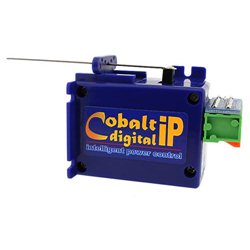
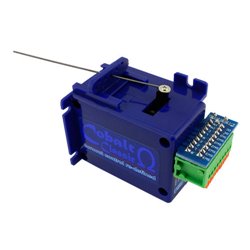
Cobalt Omega Classic Slow Action Point Motor
Price: £ 19.95Dimensions:Body only: 28mm x 38mm x 52mm deep Top overall inc Fulcrum and...
Related posts
-
 Can a "DCC ready" train be used on analogue?Yes, you can use a DCC ready train on your analogue layout. DCC ready just means that the train has been factory...
 - Is it difficult to fit a DCC decoder in to a DCC ready engine?In theory, it should be easy as the whole idea of being DCC Ready is to simplify the process. The first time I did...
- What is 7/0.2 wire?7/02 wire is a wire made of 7 strands of 0.2mm wire. Stranded wire has the advantage of being flexible while solid...
- Is an N Gauge controller compatible with OO Gauge?Yes, an N Gauge controller is compatible with OO gauge trains. You may have to change the power clip to the track...
- Is stranded wire better than solid wire?In my experience, stranded wire is preferable over solid wire. Stranded wire is more flexible than solid core wire,...