The first thing you need to know when calculating gradients is that it doesn't matter which unit of measurement you...

Cart 0 Product Products (empty)
No products
Free shipping! Shipping
£ 0.00 Total
Product successfully added to your shopping cart
Quantity
Total
There are 0 items in your cart. There is 1 item in your cart.
Total products (tax incl.)
Total shipping (tax excl.) Free shipping!
Total (tax incl.)
Search Tips
Tips categories
Latest Tips
-
 How do I calculate the space needed for an incline on my model railway layout?Read more
 -
 What are my options for motorising a level crossing?Read more
There are a few options for motorising a level crossing on a model railway layout: Servo motor: One option is to use...
-
 What is a back to back gauge?Read more
A back to back gauge is an instrument for measuring and setting up the distance between wheels on an axle of a model...
-
 How often should I run my locomotives to avoid performance issues?Read more
To avoid performance issues, it is generally recommended that modellers run their locomotives on a regular basis. The...
-
 In simple terms what is tabletop gaming?Read more
Tabletop gaming is a form of gaming where players gather around a table and use physical game pieces, such as...

What are lamp huts and where would they typically be located?
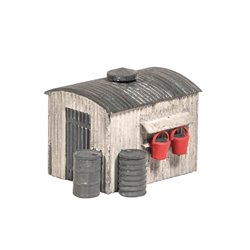
Lamp Huts were small structures, made of brick or wood that were used to store signal lamps and their associated supplies including lamp oil. These lamps were needed to illuminate signals and station buildings at night and in reduced visibility. They were quite often built with an arched roof and a ventilator cowl to vent off potentially explosive fumes from the lamp oil kept inside.
Lamp Huts were typically located at strategic points along the railway track, such as junctions, stations, and crossings. They were often positioned in a way that provided a clear view of the track and allowed the signal operator to observe the movement of trains.
Invariably the huts could also double up as a minor repair and maintenance workshop for the lamps and other associated equipment. Given the need for a large number of lamps to effectively illuminate signals and station buildings, Lamp Huts were not only a common sight but also an essential part of maintaining safe operations on the railways.
Posted in: Model Railway
Click here to receive the tips weekly in your mailbox. You can unsubscribe at any time.
Related products
Related posts
-
 What scale is Hornby?Hornby model railways are OO Scale or 1/76th that is 4 millimetres to the foot (12 inches). It runs on a track with...
 - How to weight my model so it does not tip?For wargaming figures, a small coin or washer glued to the under side of the base will usually to do the job. This...
- Is Bachmann compatible with Hornby?Yes, any OO scale loco, wagon or coach will work on any OO scale track, regardless of brand. Couplings are also...
- What are the model railway eras?According to Bachmann, as it states in their catalogue there are 9 eras. As they say in their catalogue this is not...
- Can a "DCC ready" train be used on analogue?Yes, you can use a DCC ready train on your analogue layout. DCC ready just means that the train has been factory...