Understanding the names that manufacturers give specific collections within their range can be a little bewildering...

Cart 0 Product Products (empty)
No products
Free shipping! Shipping
£ 0.00 Total
Product successfully added to your shopping cart
Quantity
Total
There are 0 items in your cart. There is 1 item in your cart.
Total products (tax incl.)
Total shipping (tax excl.) Free shipping!
Total (tax incl.)
Search Tips
Tips categories
Latest Tips
-
 What is a Eduard ProfiPACK kit?Read more
 -
 Can I connect points, signals, lights and more to a DCC controller?Read more
Under the analogue system, modellers have become accustomed to wiring their light, signal and point motor circuits...
-
 What is a push-button switch?Read more
A push-button switch is a switch that you press to operate something opposed to other types which involve moving (or...
-
 Do I need to wash my plastic kit?Read more
I personally wash all my plastic kits, I use warm soapy water (Washing up liquid) and a light rub over with a nail...
-
 Why does my railway analogue controller keep cutting out?Read more
There are a few reasons why your analogue controller could be cutting out, but the most probable cause is a short...

What is Hornby Dublo?
Hornby Dublo was an early brand name for models produced by the company that we now all know as Hornby. The brand was launched in 1938 and featured model trains that were roughly half the size of the 0 gauge models that had dominated the model railway industry for many years previously. This new manageable and affordable gauge brought the hobby that we all know and love to the masses.
WW2 saw a temporary halt to the production of Hornby Dublo models but the brand soon re-established itself afterwards all be it without clockwork models. In 1959 the three-rail track system was also dropped to keep the company current and competitive but eventually, Tri-ang's plastic-bodied models started to prove significantly popular with enthusiasts and Hornby Dublo started to fall out of favour with consumers.
In 1964 Meccano Ltd (who owned Hornby Dublo) was taken over by Lines Bros (who owned Rovex Scale Models Ltd who in turn were the producers of Tri-ang) and in 1965 the company was rebranded Tri-ang Hornby.
The new Tri-ang Hornby brand continued manufacturing models that closely resembled the original Tri-ang offerings, however, some Hornby Dublo models were to enjoy a new lease of life thanks to some of their tooling being purchased by Wrenn (who was conveniently also owned by Lines Bros) and they launched their Tri-ang Wrenn range in 1967.
The parent company that owned Tri-ang Hornby was eventually split up in 1971 and Tri-ang Hornby continued under their own steam. Still operating from their factory in Margate the company re-branded once more to become Hornby Railways and set about improving their model's specifications to make them more prototypical and appeal to a wider audience by introducing finer scale wheels, separately fitted detail and enhanced paintwork.
The Hornby Dublo story seems to be one of acquisitions and re-brands, and that's true enough but after a turbulent journey and any influence from Meccano a mere distant memory, in 2020, they're finally turning a profit and should be around for a long time to come, even if it is only the name that survives.
Posted in: Model Railway
Click here to receive the tips weekly in your mailbox. You can unsubscribe at any time.
Related products
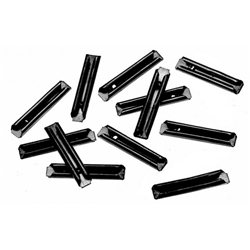
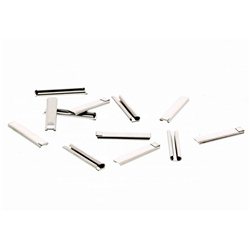
NMRA compliant fishplates (12)
Price: £ 4.25Pack of 12 fishplates for connecting lengths of flexible or semi-flexible...
Related posts
-
 What scale is Hornby?Hornby model railways are OO Scale or 1/76th that is 4 millimetres to the foot (12 inches). It runs on a track with...
 - How to weight my model so it does not tip?For wargaming figures, a small coin or washer glued to the under side of the base will usually to do the job. This...
- Is Bachmann compatible with Hornby?Yes, any OO scale loco, wagon or coach will work on any OO scale track, regardless of brand. Couplings are also...
- What are the model railway eras?According to Bachmann, as it states in their catalogue there are 9 eras. As they say in their catalogue this is not...
- Can a "DCC ready" train be used on analogue?Yes, you can use a DCC ready train on your analogue layout. DCC ready just means that the train has been factory...