A boxfile layout is a creative and compact way to build a model railway within the confines of a standard box file,...

Cart 0 Product Products (empty)
No products
Free shipping! Shipping
£ 0.00 Total
Product successfully added to your shopping cart
Quantity
Total
There are 0 items in your cart. There is 1 item in your cart.
Total products (tax incl.)
Total shipping (tax excl.) Free shipping!
Total (tax incl.)
Search Tips
Tips categories
Latest Tips
-
 What is a boxfile layout?Read more
 -
 In model railways, what does digital mean?Read more
The word 'digital' when used in model railways usually refers to a model or product being specifically manufactured...
-
 What is a Thompson bogie?Read more
Thompson bogies were the metal framework and suspension units that housed the wheelsets on Thompson railway coaches....
-
 How do you design a track plan?Read more
There are several different ways to design a track plan for your model railway project. There is no right or wrong...
-
 How to connect power across mobile baseboard section?Read more
There are a number of reasons modellers will need to create a layout in sections, some may desire a transportable...

What are the difference between Hornby and Bachmann era systems?
The era system was introduced by manufacturers to help modellers identify in which period of history their model's prototype would have been seen in service. Both Hornby and Bachmann have a system where they allocate their models a number between 1 and 9 (11 for Hornby) and each number represents a specific period in history.
Hornby and Bachmann broadly follow the same main periods of railway history as changes where obvious, huge and significant, but one or two dates and descriptions of the period do vary slightly.
- Era 1 Pioneering, Hornby use this era for models representing 1804-1869 whilst Bachmann uses the dates 1804-1875.
- Era 2 Pre-grouping, Hornby represents this period with the dates 1870 to 1922 whilst Bachmann use 1876-1922.
- Era 3 Both manufacturers class the period as 1923-1947, but Hornby calls it Grouping and Bachmann call it The Big Four.
- Era 4 Hornby use the date 1948-1956 and calls it Early BR, Bachmann uses 1948-1956 and calls it BR Early Emblem.
- Era 5 Hornby use the date 1956-1968 overlapping the previous era slightly, they call this the Late BR era, Bachmann, on the other hand, uses the date 1957-1966 and refer to it as The Late Crest era.
- Era 6 For Hornby and Bachmann this is the Pre-TOPS era with Hornby again overlapping eras, their date for this period is 1957-1971, Bachmann continues with clearer dates and uses 1967-1971.
- Era 7 Both refer to this era as BR TOPS, but for Hornby, the date is 1971-1986 whilst for Bachmann, it's 1971-1982.
- Era 8 Known as the British Rail Sectorisation era, Hornby uses the date 1982-1997 whilst Bachmann uses 1982 to 1994.
- Era 9 This is Bachmann's last official era ending with 1995 to present-day and labelling it Post-Privatisation, Hornby refers to era 9 as simply Privatisation and date it from 1996-2008.
- Era 10 (Hornby only) 2006-2017 Network Franchising.
- Era 11 (Hornby only) 2014-onwards Present Day.
The era system for both Bachmann and Hornby follow roughly the same periods in railway history and are described to give a clear indication of which period they are referring to, however, it should be noted that the list is tinkered with occasionally to make it more relevant and user friendly.
Posted in: Model Railway
Click here to receive the tips weekly in your mailbox. You can unsubscribe at any time.
Related products
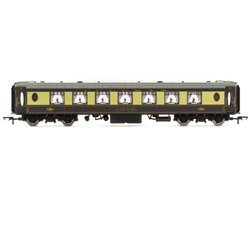
Pullman, All-steel 'K' Type Third Parlour, Car...
Price: £ 57.99Pullman, All-steel 'K' Type Third Parlour, Car No. 83 - Era 5...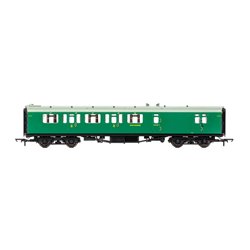
SR, Bulleid 59' Corridor Brake Third, 2846 - Era 3
Price: £ 58.50SR, Bulleid 59' Corridor Brake Third, 2846 - Era 3 Length 243mmPeriod Era 3...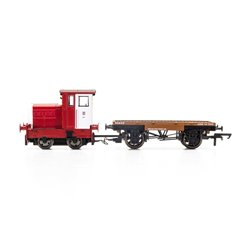
John Dewar & Sons, Ruston & Hornsby 48DS,...
Price: £ 87.99John Dewar & Sons, Ruston & Hornsby 48DS, 0-4-0, No. 458957 Length...
Related posts
-
 What scale is Hornby?Hornby model railways are OO Scale or 1/76th that is 4 millimetres to the foot (12 inches). It runs on a track with...
 - How to weight my model so it does not tip?For wargaming figures, a small coin or washer glued to the under side of the base will usually to do the job. This...
- Is Bachmann compatible with Hornby?Yes, any OO scale loco, wagon or coach will work on any OO scale track, regardless of brand. Couplings are also...
- What are the model railway eras?According to Bachmann, as it states in their catalogue there are 9 eras. As they say in their catalogue this is not...
- Can a "DCC ready" train be used on analogue?Yes, you can use a DCC ready train on your analogue layout. DCC ready just means that the train has been factory...