Tree trunks are actually grey in colour and not brown as you would think. The next time you are out and about just...

Cart 0 Product Products (empty)
No products
Free shipping! Shipping
£ 0.00 Total
Product successfully added to your shopping cart
Quantity
Total
There are 0 items in your cart. There is 1 item in your cart.
Total products (tax incl.)
Total shipping (tax excl.) Free shipping!
Total (tax incl.)
Search Tips
Tips categories
Latest Tips
-
 What colour are tree trunks?Read more
 -
 Are there any safety considerations to bear in mind when using a glass fibre pencil?Read more
A Glass Fibre Pencil is a very useful tool used which is ideally used for removing surface rust and for preparing a...
-
 How can I start a diorama?Read more
Starting a diorama is all about planning, gathering the right materials and executing your vision step by step....
-
 Alternatives to black as a wash - darken down wheel rimsRead more
Many modellers use washes to help bring out that extra level of detail in a model by creating elements of weathering...
-
 Do I need to varnish before applying a decal?Read more
It is a good idea to give your model a coat of gloss varnish before applying decals as this helps with the gluing...

What is a facing point lock in railways?
Facing point locks are commonly used throughout the world's rail systems, their function is to physically lock points in position therefore protecting trains from the points accidentally changing as a train passes over them. In the UK it is not permitted for a train to pass over points from a facing direction (diverging direction) without them being locked into place. Points are locked by the signallers using a blue lever or electronic equivalent.
The lock is only required when a train is approaching from a facing direction because when a train is merging from the opposite direction, the forces exerted on the point blades only serves to keep the points in the desired position and there is no risk to trains.
An equivalent setup exists on model points in the form of the little internal spring that keeps point blades firmly in place whilst trains pass safely by.
Posted in: Model Railway
Click here to receive the tips weekly in your mailbox. You can unsubscribe at any time.
Related products
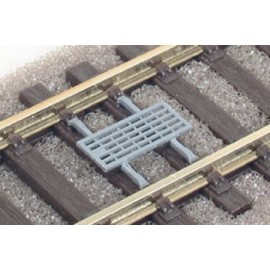
TPWS Grids - pack of 12
Price: £ 4.70TPWS Grids - pack of 12 Easily assembled kit of a Train Protection and...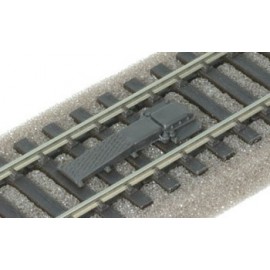
AWS Ramp - pack of 4
Price: £ 4.70AWS Ramp - pack of 4 Detailed moulding of the ramp/protective cover for the...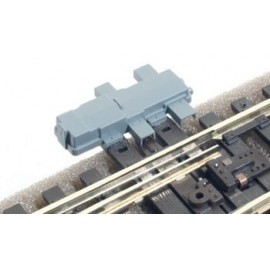
Dummy point motors - pack of 6
Price: £ 4.70Dummy point motors - pack of 6 One piece moulding adds realism to turnouts....
Related posts
-
 What scale is Hornby?Hornby model railways are OO Scale or 1/76th that is 4 millimetres to the foot (12 inches). It runs on a track with...
 - How to weight my model so it does not tip?For wargaming figures, a small coin or washer glued to the under side of the base will usually to do the job. This...
- Is Bachmann compatible with Hornby?Yes, any OO scale loco, wagon or coach will work on any OO scale track, regardless of brand. Couplings are also...
- What are the model railway eras?According to Bachmann, as it states in their catalogue there are 9 eras. As they say in their catalogue this is not...
- Can a "DCC ready" train be used on analogue?Yes, you can use a DCC ready train on your analogue layout. DCC ready just means that the train has been factory...